Skip to content
If you break ground on the public highway, you must secure the right NRSWA street works permit or licence, run a compliant traffic management layout to Chapter 8, and keep qualified operatives and supervisors on site. Do those three things consistently, submit clean permit applications, and you avoid Fixed Penalty Notices, refusals, and costly shutdowns. Highways Plus handles the admin, the TM, and the paperwork so you do not have to.
Why this guide matters if you touch the public highway
You work to tight programmes, slim margins, and unforgiving clients. Street works add another layer of risk. One missing permit, one non-compliant sign layout, or one expired SWQR card, and your site can be closed in minutes. This guide strips away confusion and shows you, step by step, how to stay legal, safe, and on schedule.
Outcome for you: fewer stoppages, fewer FPNs, fewer angry calls from the council or the principal contractor. Total peace of mind.
Quick reality check
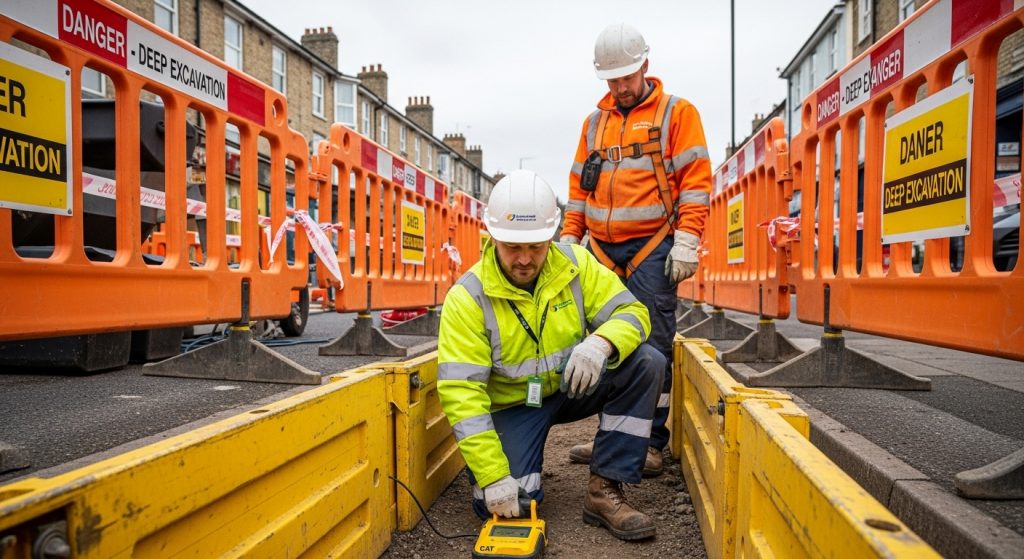
Most UK highway authorities now operate permit schemes. You need explicit permission to occupy the road, not just a notice. Poor or incomplete applications are the number one cause of delays and refusals.
The essentials in one view: permits, people, and protection
There are three pillars to staying compliant on street works. Miss any one of them and you are exposed.
Permission to work (NRSWA/TMA permits and licences)
- Classify the works correctly: Major, Standard, Minor, or Immediate. Lead times depend on this.
- Use the Street Manager service to submit applications with the right notice period.
- If you are not a statutory undertaker, you will usually need a Section 50 Street Works Licence from the highway authority.
- Expect conditions on hours, traffic management, reinstatement, and comms. Work outside of these and you risk FPNs or a stop.
Competent people (SWQR-qualified team)
- At least one qualified operative must be on site at all times, with a qualified supervisor available to oversee works. Roles are distinct.
- Ensure the correct units are present for the task at hand: LA (Location & Avoidance), O1 (Signing, Lighting & Guarding), O2 (Excavation), and relevant O3–O8 reinstatement units. Supervisors hold S1–S7 monitoring units.
- Cards expire every five years. Build renewal dates into resource planning.
Protection on site (Chapter 8-compliant TM)
- Design the layout to the Traffic Signs Manual Chapter 8: Part 1 (design) and Part 2 (operations).
- Provide clear advance warning, correct lead-in taper, a sterile safety/buffer zone, secure working space, and proper end-of-works signing.
- Keep signs clean, correctly spaced, and stable. Maintain pedestrian routes and accessibility throughout.
- Vehicles must be conspicuous: high‑visibility rear chevrons and amber beacons; all staff in BS EN ISO 20471 compliant PPE.
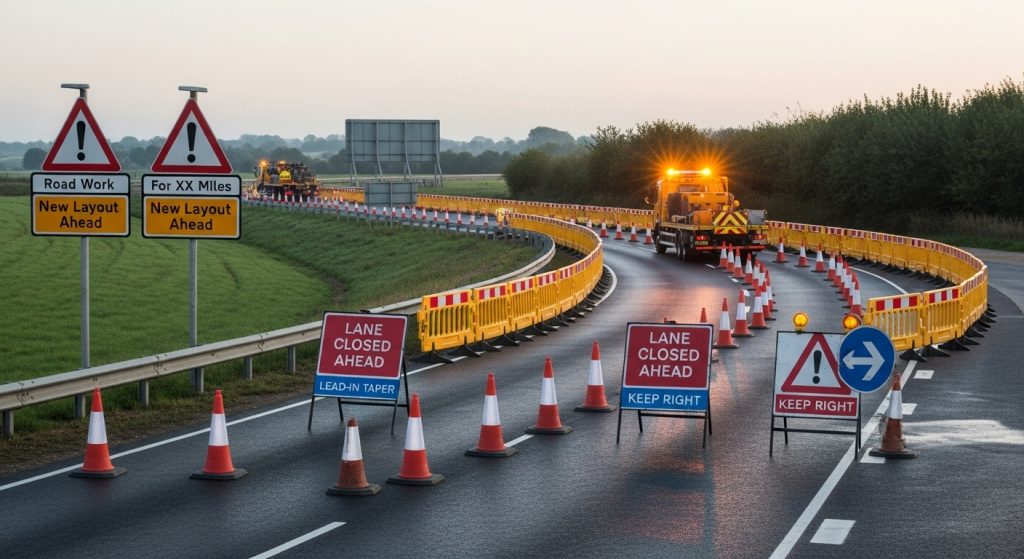
Need this handled end-to-end? Highways Plus supplies qualified crews, designs and installs TM to Chapter 8, and manages permit paperwork. See our services.
NRSWA street permit categories and lead times you can schedule against
| Permit category | Definition | Minimum notice (application to start) | Typical use case |
| Major works | 11+ working days, or requires a TTRO (e.g., road closure), or part of a long-term programme | Provisional Advance Authorisation typically 3 months before start | Utility diversions, new sewer connections, significant reconstruction |
| Standard works | Planned 4–10 working days | 10 working days | Substantial excavations, multiple joint repairs, small-scale resurfacing |
| Minor works | 3 days or less | 3 working days | Single joint-hole excavations, inspections, minor repairs |
| Immediate works | Emergency or urgent works | Apply within 2 hours of starting (or by 10:00 next working day if out of hours) | Burst mains, gas leaks, dangerous defects |
Key planning tip: build float for modification requests. Councils often ask you to shift dates or methods to avoid clashes with other works or events.
The permit application that gets approved first time
Non-negotiables to include:
- Accurate classification and street references.
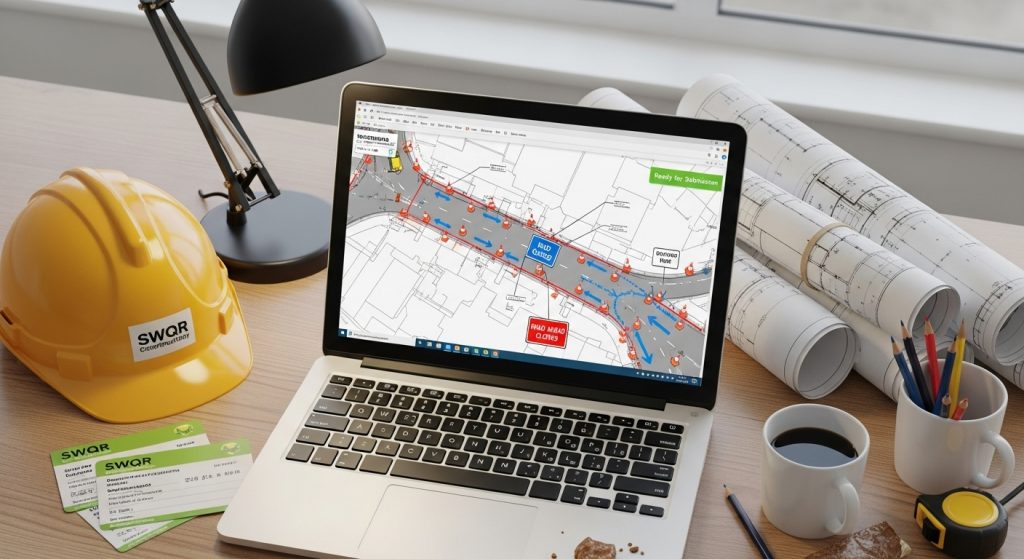
- A clean, scaled traffic management plan designed to Chapter 8.
- Work methodology and programme with realistic durations.
- Evidence of competence: SWQR units for the team, plus any NHSS accreditations.
- Reinstatement approach aligned to the Specification for the Reinstatement of Openings in Highways (SROH).
- Stakeholder comms plan for residents, bus companies, and emergency services where relevant.
Common reasons for delay or refusal:
- Missing documents, wrong drawings, or unproven qualifications.
- Clashing with other planned works because the street works register was not checked.
- Misusing the Immediate category for planned works.
- Slow responses to authority queries or skipping pre-application discussions.
- Local authority resource constraints. Submitting a complete, tidy pack the first time keeps you out of the revision queue.
Pro tip
Treat permitting like competitive tendering. A polished, compliant application moves faster and earns you a reputation that makes the next application easier.
Chapter 8 in practice: designing, installing, and maintaining TM that stands up to inspection
Design the layout (Part 1):
- Start with a site-specific risk assessment: traffic speeds, volumes, bends/crests, sight lines, footways, vulnerable users.
- Build the zonal system: Advance warning → Lead-in taper → Safety/buffer zone → Working space → End-of-works.
- Keep pedestrian routes continuous, step-free where possible, and well lit at night.
Run the site (Part 2):
- Installation sequence: build from the work area out towards approaching traffic.
- Removal sequence: reverse it. Take down advance signing last.
- Active maintenance: inspect layouts regularly, clean and re-seat signs and cones, replace failed lamps immediately.
- Vehicle conspicuity: rear chevrons and amber beacons. No exceptions.
- PPE: hi-vis to BS EN ISO 20471, plus task-driven PPE per your RAMS.
What inspectors look for: clear advance warning, correct taper length, sterile buffer zones, tidy signing, safe pedestrian management, and evidence that competent people are supervising.
The people piece: getting SWQR coverage right, every shift
Street works live or die on competence. Build rosters that guarantee the right mix of units is physically present.
- You cannot be your own operative and supervisor on the same works.
- Match units to tasks: O2 for excavations, O3–O8 for reinstatement, O1 for SLG. Supervisors mirror units with S codes.
- Track five-year renewals. Expired cards equal non-compliance and stoppages.
- Keep copies of cards and unit matrices in your site file for spot checks.
Highways Plus does this for you. We resource by unit coverage, not just headcount, so reinstatement does not stall because the wrong card is on site.
Penalties and pain: what happens if you get it wrong
Expect Fixed Penalty Notices (FPNs) for working without a valid permit, breaching permit conditions, or failing to send start/stop notices. Serious or repeated breaches can trigger escalated enforcement, reputational damage, and programme slippage you cannot recover.

Cost insight
Poor reinstatement shortens pavement life and creates repeat defects. Utilities and their contractors end up paying twice: once to do it cheaply, and again to fix the failure. Quality first-time reinstatement protects budgets and brand.
Make compliance someone else’s problem
You do not need to hold all this in your head. Highways Plus acts as your low-maintenance, fully compliant street works partner. We:
- Classify works, design TM, and draft permit packs that pass first time.
- Supply SWQR-qualified crews with the right unit coverage, every shift.
- Install, inspect, and maintain Chapter 8 layouts to the letter.
- Reinstated finishes meet SROH and stand up to inspection.
- Handle comms, notices, and close-out in Street Manager.
Explore what we do on our services page, or speak to the team via contact.
NRSWA street works FAQs
Do I always need a NRSWA permit for street works?
In most areas, yes. Permit schemes now cover the majority of authorities. Even emergencies require a retrospective permit within strict time limits.
We are not a utility. Can we still open the highway?
Usually, yes, via a Section 50 Street Works Licence issued by the highway authority. Expect technical conditions and inspections.
Who must be on site for competence?
At least one SWQR-qualified operative must be physically on site at all times. A SWQR-qualified supervisor must oversee the works and be available to attend.
What does ‘Chapter 8 compliant’ actually mean?
It means your signing, lighting, and guarding meet the Traffic Signs Manual Chapter 8 standards for design and operation, including correct zone set‑up, tapers, conspicuity, lighting, and active maintenance.
How do I avoid NRSWA street works permit refusals?
Submit a complete, tidy pack: correct classification, strong TM design, evidence of competence, realistic durations, and early coordination with other works. Respond quickly to queries.
What about pedestrians and accessibility?
Provide a continuous, safe route with appropriate barriers, ramps, and lighting. Plan for pushchairs, wheelchair users, and visually impaired users from the outset.
External resources you may find useful
- GOV.UK – Permit schemes: statutory guidance for highway authorities: https://assets.publishing.service.gov.uk/media/643675aa877741001368d834/permit-schemes-statutory-guidance-july-2022.pdf
- GOV.UK – Street works qualifications in England (SWQR): https://www.gov.uk/government/publications/street-works-qualifications-in-england/street-works-qualifications-in-england-guidance-for-operatives-and-supervisors
- GOV.UK – Traffic Signs Manual Chapter 8 (Part 1 & Part 2): https://assets.publishing.service.gov.uk/media/5a74adeaed915d7ab83b5ab2/traffic-signs-manual-chapter-08-part-01.pdf and https://assets.publishing.service.gov.uk/media/5a7cc632e5274a38e5756aa3/traffic-signs-manual-chapter-08-part-02.pdf
Key takeaways
- Classify works correctly, then plan to the right notice period.
- Submit a complete permit pack with a Chapter 8 TM plan, competence evidence, and realistic durations.
- Keep one qualified operative on site at all times, with a qualified supervisor overseeing.
- Install TM from the work area outwards; remove in reverse. Inspect, clean, and adjust frequently.
- Reinstate to SROH. Close out promptly in Street Manager with as‑built and photos.
- Track SWQR renewals and unit coverage per shift.
Compliance is not admin. It is risk management. Get it right and your programme runs, your margins hold, and your reputation grows.
Get the NRSWA Compliance Checklist. Want the editable version we use on live sites? Message the team and we will send it over today.