Skip to content
Why UK developers are losing millions to adoption delays, and what you can do about it.
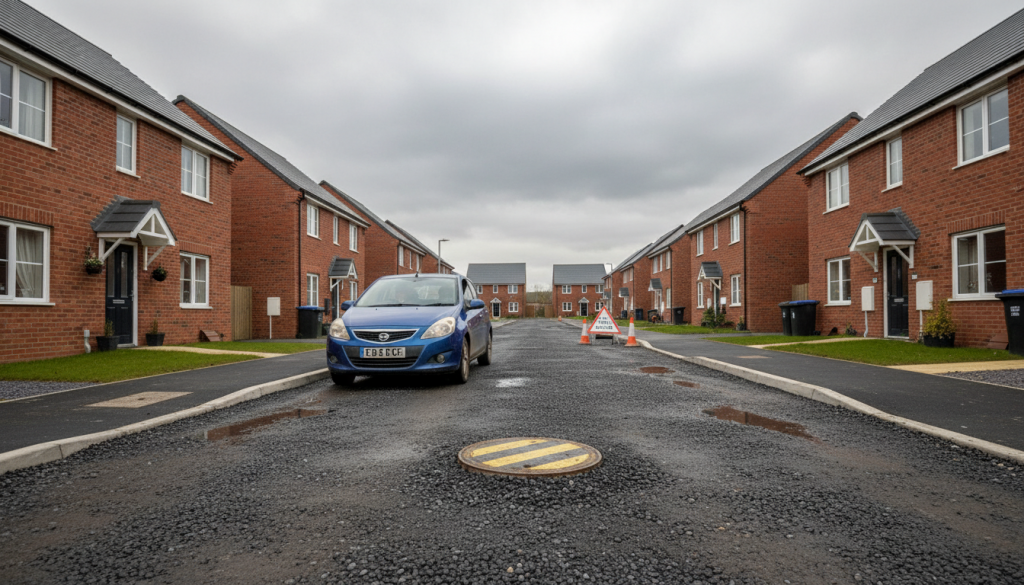
Picture this: your development’s complete, buyers are moving in, and you’re ready to hand over to the management company. Except there’s one small problem. The roads still aren’t adopted. The sewers are stuck in some bureaucratic black hole. And that nice, tidy exit you’d planned? It’s now a very expensive ongoing headache.
If this sounds familiar, you’re not alone. Across the UK, developers are grappling with ‘The Adoption Crisis’ that’s turning profitable projects into financial nightmares.
Here’s what we’re seeing on the ground: highway adoption timelines that should take 12-18 months are stretching to three, four, even five years. Costs that were budgeted at £50,000 are hitting £500,000 or more. And that’s before you factor in the opportunity costs, the professional fees, and the reputational damage.
So what’s going wrong? And more importantly, what can you do to protect your next project?
Let’s dig into the numbers, and the solutions.
The Scale of the Problem
By the Numbers: It’s Worse Than You Think
The statistics around adoption delays make for grim reading. According to recent data from Local Highway Authorities across England, the average Section 38 highway adoption process now takes significantly longer than the statutory guidance suggests.
But averages don’t tell the whole story. Here’s what the data actually shows:
- Only 45% of Section 38 applications receive technical approval on first submission
- Average processing time has increased by 40% since 2019
- Cost escalations of 200-400% above initial estimates are becoming routine
- Extended maintenance periods now affect over 60% of developments
“We’re seeing developers who budgeted £30,000 for adoption ending up with bills north of £200,000. It’s not just the direct costs, it’s the extended professional fees, the insurance premiums, the working capital that’s tied up for years longer than planned.” , Tony Flook, Managing Director, Highways Plus
And that’s just highways. Sewer adoption under the new Design and Construction Guidance (DCG) has introduced additional complexity that many developers are still getting to grips with.
Real-World Impact: Beyond the Spreadsheets
Let’s talk about what these delays actually mean for your business:
Cash Flow Carnage When roads aren’t adopted, you can’t hand over maintenance responsibilities. You’re stuck paying for street cleaning, lighting maintenance, road repairs, indefinitely. On a 200-unit development, that can easily run £15,000-£25,000 per year.
Programme Domino Effects Adoption delays don’t just affect the current project. They tie up professional teams, delay bond releases, and can push back future project starts. The knock-on effects can derail your entire development pipeline.
Relationship Damage Nothing sours relationships with buyers, management companies, and local authorities faster than unresolved adoption issues. And in an industry that runs on relationships, that damage can be expensive.
Root Causes of Adoption Delays
Design Phase Bottlenecks: Where It All Goes Wrong
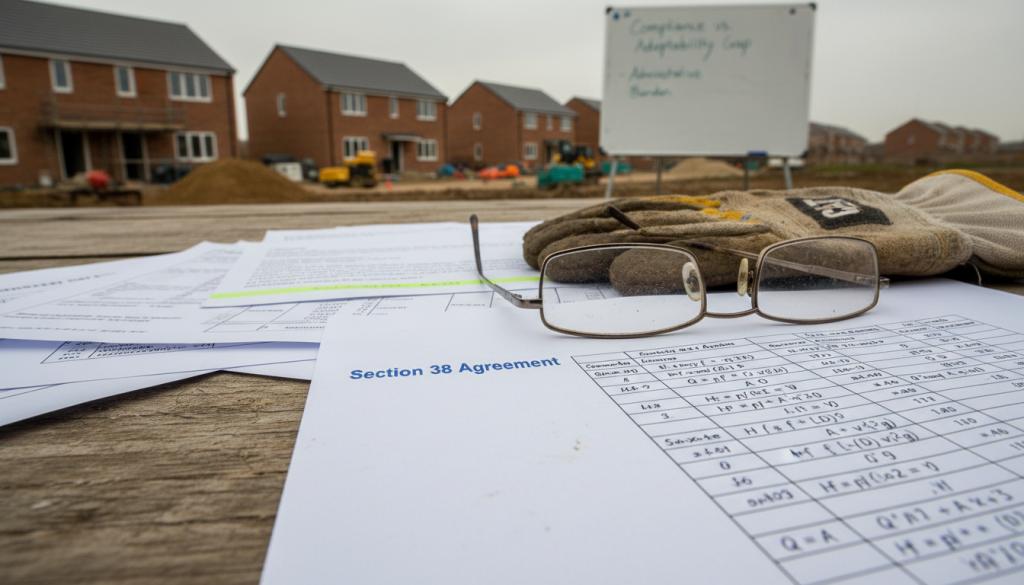
Most adoption problems start way before anyone picks up a spade. They start in the design office, where well-meaning engineers create technically compliant designs that completely fail to meet adoption requirements.
The Compliance vs. Adoptability Gap Here’s something that catches people out: meeting planning conditions isn’t the same as meeting adoption standards. Your highways can be perfectly compliant with planning requirements and still get rejected by the adoption authority.
Common design phase failures include:
- Non-compliant drainage calculations that look fine on paper but fail real-world testing
- Material specifications that don’t match the authority’s preferred supplier lists
- Construction details that ignore local construction practices
- Utility coordination that assumes everyone will play nicely together
The Pre-Application Lottery Developers are encouraged to approach the council at the earliest opportunity to discuss proposals and adoption requirements. But “encouraged” is doing some heavy lifting there.
Some authorities provide excellent pre-application services. Others? You might wait weeks for a response that tells you to submit a formal application to find out what they actually want.
Construction Quality Issues: The Expensive Mistakes
Even when your design gets approved, construction quality can derail adoption faster than anything else. And once work’s in the ground, fixing problems becomes exponentially more expensive.
The Most Common Construction Failures:
| Issue Type | Typical Cost to Fix | Time Impact | Why It Happens |
| Compaction failures | £15,000-£50,000 | 4-8 weeks | Inadequate supervision during backfilling |
| Drainage defects | £20,000-£80,000 | 6-12 weeks | Poor joint construction or settlement |
| Levels and gradients | £10,000-£40,000 | 3-6 weeks | Survey errors or construction drift |
| Materials non-compliance | £25,000-£100,000+ | 8-16 weeks | Using non-approved materials or suppliers |
“The most expensive phone call I ever take is the one where a developer calls six months after construction asking why their adoption isn’t progressing. By then, fixing problems costs ten times what prevention would have cost.” , Ben Sperring, Surfacing and Civils Manager, Highways Plus
Inadequate Quality Assurance We’ve seen too many projects where quality assurance means “the contractor says it’s fine.” That’s not quality assurance, that’s hoping for the best.
Effective QA during construction means:
- Independent testing (not just relying on contractor results)
- Regular progress meetings with adoption authorities
- Photographic records of every construction stage
- Immediate defect rectification rather than “we’ll sort it later”
Administrative and Process Failures
Sometimes the design’s right, the construction’s perfect, but the adoption still gets stuck because of administrative failures.
Documentation Disasters As-built drawings that don’t reflect actual construction. Materials certificates that can’t be located. Test results that don’t match the specification. Any one of these can halt adoption progress for months.
The adoption process can be lengthy and while the road is unadopted, the developer is responsible for maintaining the road until adoption happens. During this period, incomplete documentation becomes your worst enemy.
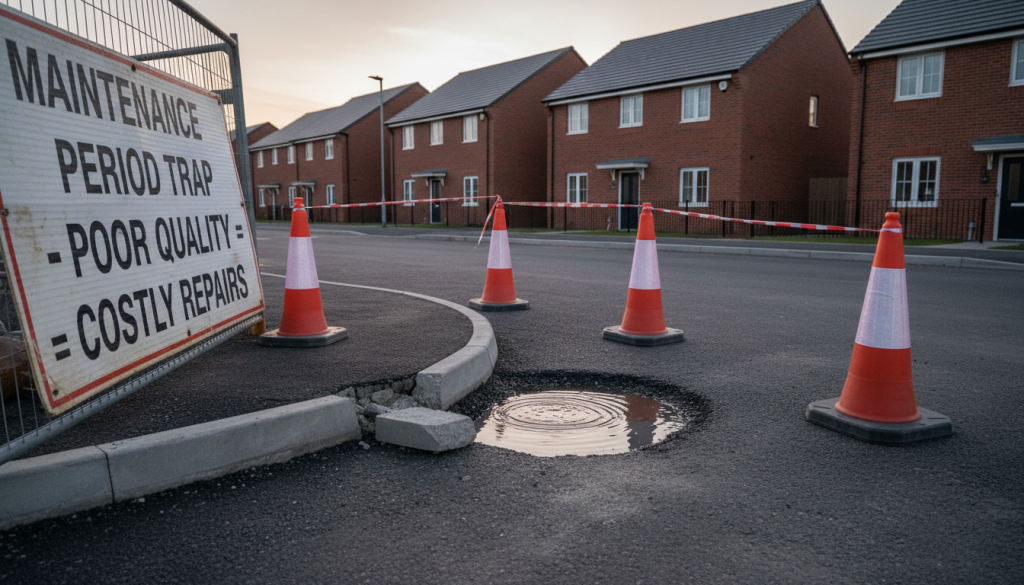
The Maintenance Period Trap Most developers think the maintenance period is passive, you wait 12 months, then get adopted. Wrong.
The maintenance period is an active testing phase where any defects, damage, or performance issues can reset the clock. We’ve seen maintenance periods extended multiple times due to:
- Winter damage that wasn’t properly anticipated
- Utility strikes during the maintenance period
- Settlement issues that only become apparent over time
- Third-party damage that somehow becomes the developer’s responsibility
LHA Resource Constraints and Backlogs
The Approval Bottleneck: Why Everything Takes Forever
Let’s be honest about something: many Local Highway Authorities are understaffed, under-resourced, and struggling to keep up with application volumes.
According to ADEPT surveys, technical approval teams across England are operating with significant capacity constraints. The average LHA technical team has seen staffing levels reduce by 25% since 2015, while application volumes have increased by 35%.
What This Means for Your Applications:
- Longer review times as applications queue for available resources
- Less time for pre-application advice and relationship building
- Risk-averse decision making as overworked teams default to rejection rather than working through issues
- Inconsistent interpretations as different team members apply standards differently
Priority Games Not all applications are treated equally. LHAs typically prioritise based on:
- Development size (larger developments get more attention)
- Local political importance (housing developments near town centres often jump the queue)
- Developer relationship (developers with good track records get faster responses)
- Application quality (well-prepared submissions move faster)
Impact on Development Programmes
These capacity constraints create knock-on effects throughout your development programme:
Planning Condition Discharge Delays Highway adoption is often tied to planning condition discharge. If adoption’s delayed, you can’t discharge conditions. If you can’t discharge conditions, you can’t start sales or secure final funding.
Sales and Marketing Impacts Try explaining to potential buyers why the roads might not be adopted for “a while.” It’s not a conversation that helps with sales velocity.
Finance and Investment Consequences Lenders and investors are increasingly sophisticated about adoption risk. Extended adoption timelines can trigger additional security requirements, higher interest rates, or even funding withdrawal.
Cost Escalation Mechanisms: Where the Money Goes

Direct Cost Increases: The Obvious Ones
When adoption gets delayed, the direct costs are painful enough:
Extended Professional Fees Your adoption consultant doesn’t work for free. Neither do your lawyers, project managers, or technical specialists. When a 12-month adoption stretches to 36 months, professional fees can triple.
Additional Testing Requirements Extended programmes often trigger additional testing requirements. Drainage systems might need re-surveying. Road surfaces might need re-testing. Each round of additional testing typically costs £3,000-£8,000.
Remediation Work Costs Problems identified during extended adoption processes need fixing. And problems that have been in the ground for two years are generally more expensive to fix than fresh construction issues.
Indirect Financial Impact: The Hidden Killers
But it’s the indirect costs that really hurt:
Carrying Costs on Unsold Units If adoption delays prevent final sales completion, you’re carrying financing costs on unsold inventory. On a £40 million development, that’s potentially £2-3 million in additional finance costs per year.
Marketing and Sales Delays Adoption uncertainty makes properties harder to sell and potentially impacts achievable sale prices. Even a 5% impact on sale prices can dwarf the direct adoption costs.
Reputation and Relationship Damage Poor adoption outcomes affect future project negotiations. Authorities remember developers who cause problems. Buyers remember developments with ongoing issues.
Cost Escalation Example:
| Cost Category | Original Budget | After 24-Month Delay | Increase |
| Professional fees | £25,000 | £65,000 | 160% |
| Additional testing | £5,000 | £18,000 | 260% |
| Remediation works | £10,000 | £45,000 | 350% |
| Maintenance costs | £8,000 | £32,000 | 300% |
| Finance carrying costs | £80,000 | £240,000 | 200% |
| Total Impact | £128,000 | £400,000 | 213% |
Breaking the Cycle: Prevention Strategies
Upfront Investment in Quality
The best way to handle adoption delays? Prevent them happening in the first place.
Design Phase Best Practices
- Early engagement with adoption authorities (before you finalise designs, not after)
- Local standards research that goes beyond published guidance
- Utility coordination that actually involves the utility companies
- Buildability reviews by people who’ve actually built adoptable infrastructure
Professional Team Selection Don’t just hire the cheapest consultants. Hire people who’ve successfully navigated adoption with your target authorities.
Ask potential consultants:
- How many Section 38 adoptions have you completed with [specific authority]?
- What’s your average time from submission to adoption?
- Can you provide references from recent projects?
- How do you handle coordination with utilities and other specialists?
Proactive Problem Management
Early Warning Systems Set up systems that identify problems before they become crises:
- Weekly progress reviews with adoption authorities
- Regular stakeholder meetings between all parties
- Issue escalation procedures that resolve problems quickly
- Performance monitoring against planned timelines
Quality During Construction
- Independent supervision (not just contractor self-certification)
- Real-time testing with immediate results and corrective action
- Photographic documentation of every construction stage
- Regular liaison with adoption authority inspectors
When Problems Have Already Occurred
Rapid Diagnosis: Getting to the Root Cause
If you’re already facing adoption delays, the first step is understanding exactly what’s gone wrong. And we mean exactly, not just “the council’s being difficult.”
Root Cause Analysis Framework:
- Technical compliance review: Do your works actually meet current standards?
- Documentation audit: Is your paperwork complete and accurate?
- Process review: Are you following the correct procedures for your authority?
- Relationship assessment: Have stakeholder relationships broken down?
Priority Setting Not all problems are equally important. Focus first on issues that:
- Completely block adoption progress
- Create safety or liability concerns
- Affect multiple work packages
- Require long lead times to resolve
Accelerated Resolution Approaches
When adoption’s already delayed, you need strategies that compress timelines rather than following standard processes:
Focused Remediation Planning
- Work package prioritisation to unlock critical path activities
- Resource mobilisation to tackle multiple issues simultaneously
- Stakeholder alignment to ensure everyone’s working towards the same goals
- Alternative compliance routes where standard approaches aren’t working
Our Backlog Defect Resolution Service has helped developers unlock millions in stalled value by taking exactly this approach, systematic problem-solving that compresses resolution timelines.
Taking Action: Your Next Steps
Adoption delays aren’t inevitable. They’re predictable, preventable, and (when they do occur) resolvable with the right approach.
If you’re planning a new development:
- Start adoption conversations during design development, not after planning approval
- Budget realistically for adoption costs (including contingencies for delays)
- Select professional teams based on adoption experience, not just lowest cost
- Build quality management systems that prevent problems rather than just detecting them
If you’re already facing delays:
- Get an independent assessment of what’s actually causing the hold-up
- Develop a recovery plan that addresses root causes, not just symptoms
- Consider specialist support to accelerate resolution
- Document lessons learned to prevent repeat issues on future projects
The adoption landscape will continue evolving. New standards, climate adaptations, digital processes, it’s all coming. But developers who master the current system and build robust processes will adapt successfully to whatever changes lie ahead.
Don’t let adoption delays derail your next project. Take control.
Get Expert Help Today
Download our comprehensive guide: The Developer’s Guide to Navigating Highway & Sewer Adoptions in the UK – includes detailed checklists, cost planning tools, and risk management frameworks.
Need immediate support? Our adoption specialists can provide rapid assessment and resolution strategies for stalled projects.
Helping developers across the South West, Thames Valley and South Wales navigate adoption challenges with five decades of highways expertise.
Contact Highways Plus for specialist support:
- Phone: 01761 202 012
- Email: info@highwaysplus.co.uk
Frequently Asked Questions
Q: What’s the average highway adoption timeline in 2024?
A: While statutory guidance suggests 12-18 months, current reality shows most Section 38 adoptions taking 18-30 months, with complex projects often extending beyond that. The key is early engagement and quality management to avoid the delays that push timelines to 3+ years.
Q: How much do adoption delays typically cost developers?
A: Direct costs (professional fees, additional testing, remediation) typically increase by 200-400% for significantly delayed projects. But indirect costs (finance charges, carrying costs, opportunity costs) often dwarf the direct expenses. A 24-month delay on a £20 million development can easily cost £500,000-£1 million in total impact.
Q: Can adoption timelines be shortened legally?
A: Direct costs (professional fees, additional testing, remediation) typically increase by 200-400% for significantly delayed projects. But indirect costs (finance charges, carrying costs, opportunity costs) often dwarf the direct expenses. A 24-month delay on a £20 million development can easily cost £500,000-£1 million in total impact.
Q: What triggers extended maintenance periods?
A: Extended maintenance periods typically result from defects discovered during the standard 12-month period, seasonal damage (especially winter-related), third-party damage, or settlement issues. Each extension usually adds 6-12 months to the overall timeline.
Q: How do you prioritise multiple adoption applications with the same authority?
A: LHAs typically prioritise based on development size, local political importance, application quality, and developer track record. Building strong relationships and submitting high-quality applications consistently improves your position in the queue.