Skip to content
Picture this: a regional housebuilder with 47 completed plots, buyers ready to exchange, and £2.3 million in capital locked behind a single piece of paper. The estate roads? Finished 14 months ago. The Section 38 adoption certificate? Still sat in a council technical approval queue with no clear end date.
Sound familiar?
The traditional Section 38 adoption timeline has become a commercial millstone for UK developers. What should be a straightforward administrative process routinely stretches from 12 to 36 months, trapping capital, delaying plot completions, and creating genuine financial pain. But here’s the thing: it doesn’t have to be this way.
The difference between a 12-month adoption headache and a six-week Section 38 agreement success story isn’t luck. It’s process, planning, and partnering with specialists who understand exactly what local authorities need to see.
Key takeaways
- Traditional Section 38 adoption timelines of 12-36 months are driven by preventable bottlenecks in design, inspection scheduling, defect loops, and maintenance period management.
- Pre-planning design decisions (drainage integration, road safety audit compliance, material specifications) determine 70% of your final adoption speed.
- Accelerated six-week adoption is achievable through front-loaded technical approval, compliance-ready construction, and specialist adoption management.
- Bond release and capital unlock happen faster when developers structure programmes with inspection milestones, fixed-fee certainty, and single point of accountability.
- Specialist partners compress timelines by managing council relationships, pre-empting technical objections, and delivering defect-free infrastructure from day one.
Understanding the traditional Section 38 adoption timeline (and why it’s broken)

Let’s start with what we’re actually dealing with. A Section 38 agreement is the legal mechanism under the Highways Act 1980 that transfers new estate roads from private developer ownership to local highway authority maintenance responsibility.[1]
The process sounds simple on paper:
- Design approval
- Bond lodgement
- Construction and inspection
- Maintenance period (typically 12 months)
- Final inspection and certificate
- Adoption and bond release
In practice? That’s where things fall apart.
The 12 to 36 month reality
Tony Flook, Managing Director at Highways Plus, has watched this pattern repeat for three decades:
“Developers often treat Section 38 adoption as an afterthought, something to sort out once the roads are built. By that point, you’re already 18 months behind. The councils we work with aren’t being difficult, they’re just responding to incomplete applications, non-compliant designs, and construction that doesn’t match the approved drawings. Every one of those issues adds months to your timeline.”
The Government’s own Highways Adoption Advice Note acknowledges typical timescales can extend well beyond 12 months, particularly where technical compliance issues emerge during the maintenance period.[1] Kirklees Council’s guidance suggests developers should anticipate the full seven-step process taking 18-24 months under normal circumstances.[3]
But “normal” often means much longer.
What actually causes Section 38 adoption timeline delays?
The bottlenecks aren’t mysterious. They’re predictable, measurable, and in most cases, entirely preventable. Here’s what’s really happening:
❌ Design approval ping-pong (3-8 months)
Initial technical submissions that don’t align with local authority design guides trigger rejection cycles. Each round trip adds 6-12 weeks. Common issues include:
- Drainage designs that don’t integrate with Section 104 sewer adoption requirements
- Road safety audit findings not addressed at Stage 1
- Non-compliant kerb radii, visibility splays, or gradient specifications
- Missing commuted sum calculations for specialist materials[2]
❌ Inspection scheduling gaps (2-6 months)
Council highway inspectors work across multiple developments. Without proactive scheduling and notice, inspection visits slip. Construction progresses without sign-off, creating compliance uncertainty and rework risk.
❌ Defect remediation loops (4-12 months)
This is the killer. Defects identified during the maintenance period restart the clock. Surface failures, drainage issues, settlement problems – each triggers a fix-and-wait cycle that can add a year to your Section 38 adoption timeline.
Ben Sperring, Surfacing and Civils Manager at Highways Plus, sees this constantly:
“The defects we’re called in to fix aren’t usually catastrophic failures. They’re specification issues. Wrong aggregate grading, inadequate compaction, drainage connections that don’t quite meet the approved levels. Individually small, collectively devastating for your adoption programme. The tragedy is that every single one was preventable with proper site supervision and compliance-ready construction from the start.”
❌ Maintenance period waiting time (12+ months)
Even perfect construction requires a statutory maintenance period. But many developers don’t realise this clock only starts once all initial defects are resolved. A single outstanding item can delay the start of your 12-month countdown indefinitely.
❌ Bond release bureaucracy (2-4 months)
Final inspections, certificate preparation, and bond release administration add further delay, particularly where multiple parties (council legal, highways, finance departments) need to coordinate sign-off.
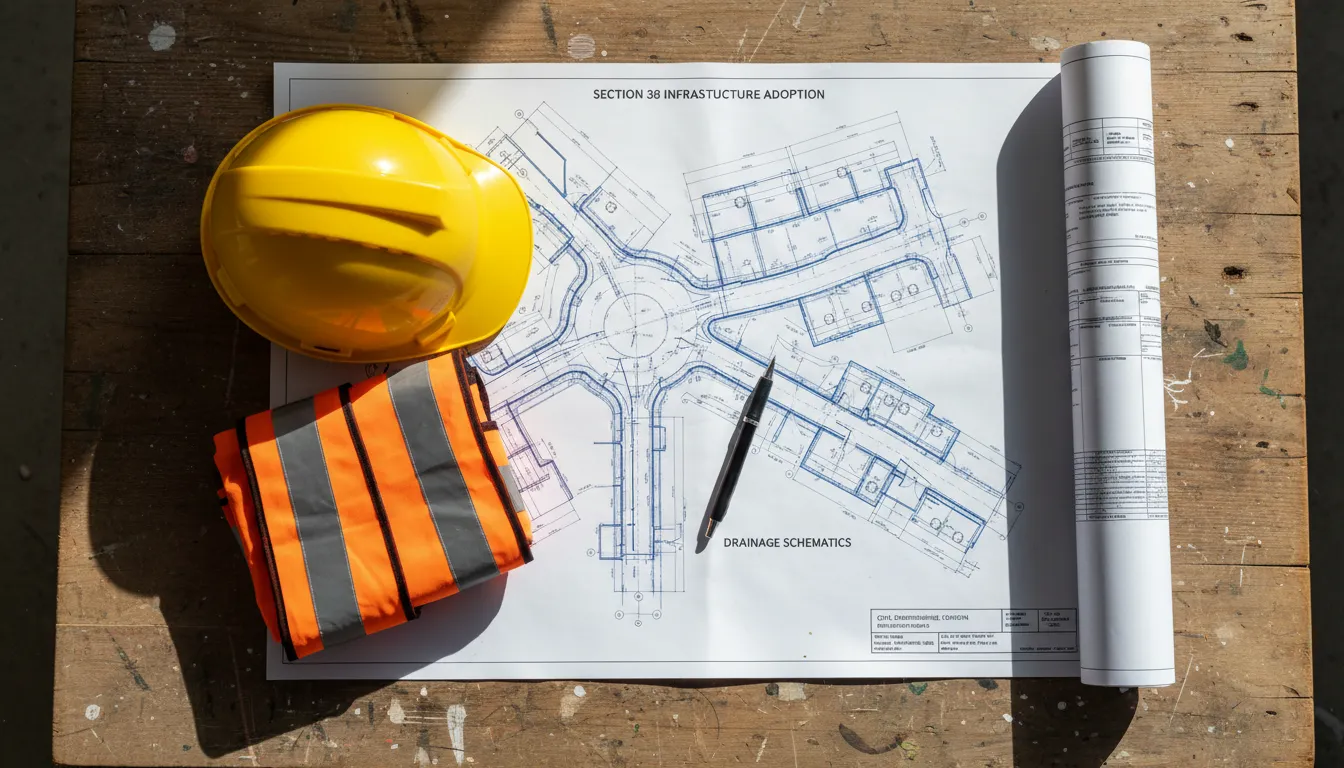
How to compress your Section 38 adoption timeline to 6-12 weeks
The developers achieving rapid adoption aren’t cutting corners. They’re front-loading compliance, building to adoptable standards from day one, and treating adoption as a programme-critical milestone rather than an administrative afterthought.
Here’s the roadmap:
✅ Pre-planning design decisions (the 70% rule)
Your Section 38 adoption timeline is largely determined before a single metre of tarmac is laid. Design decisions made at planning stage dictate:
- Drainage integration: Coordinating highway drainage with sustainable drainage systems (SuDS) and Section 104 sewer adoption requirements eliminates later conflicts[2]
- Material specifications: Choosing council-approved materials and construction methods (not just ‘equivalent’ alternatives) removes technical approval friction
- Road safety audit compliance: Addressing Stage 1 RSA findings before detailed design is finalised prevents costly redesign
- Visibility and geometry: Getting junction radii, forward visibility splays, and gradient transitions right first time
Leicestershire’s Highway Design Guide is explicit: technical approval applications that don’t demonstrate compliance with local standards face rejection.[2] Every rejection adds 8-12 weeks to your timeline.
The Highways Plus approach: We work with developers at pre-planning stage to ensure designs meet local authority technical approval standards before submission. That’s not just faster, it’s fixed-fee certainty with programme certainty baked in.
✅ Early technical approval and bond strategy
Don’t wait until construction is ready to start your Section 38 application. Submit for technical approval as soon as detailed designs are finalised. This parallel-tracks approval with your construction programme.
Bond lodgement should happen immediately after technical approval, not when you’re ready to start on site. This removes a 4-8 week administrative delay from your critical path.
✅ Compliance-ready construction with inspection milestones
Here’s where specialist delivery partners create genuine acceleration. Commercial surfacing services that understand adoptable highway standards deliver:
- Material compliance: Certified aggregates, proven binder specifications, documented compaction results
- Dimensional accuracy: Kerb lines, crossfall gradients, and drainage levels that match approved drawings within tolerance
- Proactive inspection scheduling: Stage inspections booked in advance, with council officers notified and works sequenced to match their availability
- First-time sign-off: Construction quality that passes inspection without remedial loops
This isn’t theoretical. Highways Plus routinely delivers defect resolution and new build surfacing that achieves first-time council approval because we build to adoptable standards as baseline, not aspiration.
✅ Compressed maintenance periods (where regulations allow)
Some local authorities will accept reduced maintenance periods (6 months rather than 12) for low-risk developments or where the developer has a proven track record. This requires early dialogue and demonstrated competence.
Even where 12-month periods are mandatory, you can accelerate by ensuring the maintenance period clock starts immediately after practical completion, not after a defect remediation delay.
✅ Adoption management and single point of accountability
The fastest Section 38 adoptions happen when a single specialist partner manages the entire process: design liaison, construction, inspections, defect management, and council coordination.
This eliminates the coordination gaps that plague multi-contractor approaches. When your surfacing contractor, drainage installer, and adoption consultant are different companies, accountability blurs and timelines extend.
Case study snapshot: A Midlands developer with 12 months of adoption delays across three schemes brought Highways Plus in to manage Section 38 adoption on a new 34-plot development. By integrating design review, compliance-ready surfacing, and proactive council liaison, we achieved final adoption certificate in nine weeks from practical completion. The difference? De-risked delivery with whole-life value built into the specification.
Structuring your Section 38 programme for speed
A compressed Section 38 adoption timeline requires programme discipline. Here’s the structure that works:
| Phase | Traditional Timeline | Accelerated Timeline | Critical Success Factors |
|---|---|---|---|
| Design & Technical Approval | 4-8 months | 6-10 weeks | Pre-submission design review, local authority engagement, compliance-ready drawings |
| Bond Lodgement | 4-8 weeks | 1-2 weeks | Early bond arrangement, approved technical drawings ready |
| Construction & Inspections | 6-12 months | 8-16 weeks | Stage inspection scheduling, compliance-ready construction, single point of accountability |
| Maintenance Period | 12+ months (often delayed) | 6-12 months (starts immediately) | Defect-free handover, proactive monitoring, rapid response protocols |
| Final Inspection & Certificate | 8-16 weeks | 2-4 weeks | Complete documentation, pre-inspection liaison, council relationship management |
| Total Programme | 24-36+ months | 10-16 months | Front-loaded compliance, specialist delivery partner |
Notice the accelerated timeline still includes a realistic maintenance period. You can’t eliminate statutory requirements, but you can prevent the delays that extend them.
The role of specialist adoption management partners
This isn’t about outsourcing responsibility. It’s about partnering with specialists who’ve managed hundreds of Section 38 adoptions and know exactly what councils need to see.
What specialist partners deliver:
🔧 Technical approval navigation: Understanding local authority design guides, pre-empting technical objections, and structuring submissions for first-time approval
🔧 Compliance-ready construction: Road construction and surfacing built to adoptable standards from day one, eliminating defect loops
🔧 Inspection coordination: Proactive scheduling, council relationship management, and documentation that supports rapid sign-off
🔧 Defect resolution: Rapid mobilisation to address any maintenance period issues, preventing timeline extensions
🔧 Bond release management: Coordinating final inspections, certificate preparation, and financial release
Tony Flook puts it simply:
“Your project is our business. When developers partner with Highways Plus for Section 38 adoption, they’re not just buying surfacing services. They’re buying 30 years of council relationships, technical approval expertise, and a track record of delivering adoptable infrastructure that passes first-time inspection. That’s what compresses a 24-month timeline to 12 weeks.”
Council standards, safety audits, and drainage: the technical reality
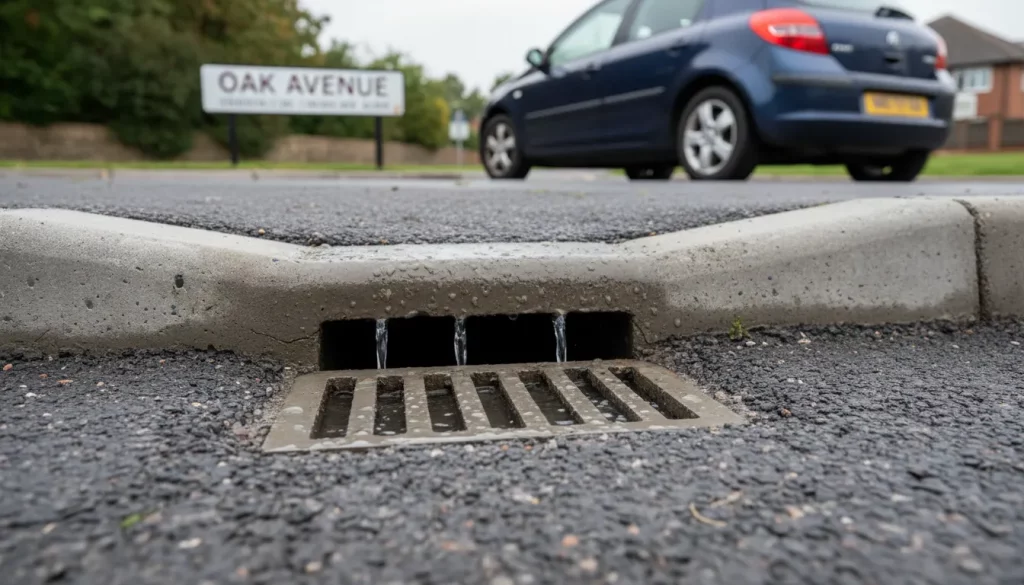
Local authority technical approval isn’t arbitrary bureaucracy. Highway authorities accept long-term maintenance liability for adopted roads, so their standards protect public funds and road user safety.
Key technical approval factors:
📋 Design guide compliance: Each council publishes technical standards (geometry, materials, construction methods). Leicestershire’s guide runs to 200+ pages of detailed specifications.[2] Non-compliance means rejection.
📋 Road safety audits: Stage 1 audits identify design safety issues. Stage 2 audits review detailed designs. Stage 3 audits assess completed construction. Unresolved audit findings block adoption.[1]
📋 Drainage design: Highway drainage must integrate with broader surface water management, meet flood risk requirements, and align with Section 104 sewer adoption if applicable. Drainage failures are the most common cause of maintenance period defects.[2]
📋 Commuted sums: Specialist materials (block paving, decorative surfaces) require upfront payments to cover future maintenance costs. These calculations must be agreed before adoption.[2]
Understanding these requirements at design stage is what separates a six-week adoption from a 36-month ordeal.

Practical steps for live and backlog schemes
Got schemes stuck in adoption limbo? Here’s your action plan:
For live developments (pre-construction):
- Commission design review with adoption specialists before submitting technical approval
- Engage council highways early to understand local requirements and inspection expectations
- Integrate Section 38 and Section 104 drainage requirements in a single coordinated design
- Appoint a single delivery partner with proven adoption track record for surfacing and civils
- Build inspection milestones into your construction programme with council availability confirmed
For backlog schemes (post-construction):
- Audit current status: What’s actually preventing adoption? Defects, paperwork, maintenance period not started?
- Commission defect survey by adoption specialist to identify remedial scope
- Engage council proactively to agree remedial programme and timeline
- Execute fixes with compliance focus: Don’t just patch problems, resolve them to adoptable standards
- Manage maintenance period actively: Regular inspections, rapid response to emerging issues
Ben Sperring has rescued dozens of stalled schemes:
“The backlog schemes we take on usually have three or four outstanding defects that have been ‘temporarily fixed’ multiple times. Our approach is simple: identify the root cause, specify a permanent compliant solution, execute it properly, and document everything for the council. It’s not glamorous, but it’s what unlocks bond release and capital.”
Frequently asked questions
How long does Section 38 adoption typically take from technical approval to final certificate, and what drives that timeline in practice?
From technical approval to final adoption certificate, the statutory minimum is typically 12-18 months (construction plus 12-month maintenance period). In practice, 24-36 months is common due to inspection delays, defect remediation loops, and maintenance period restarts. The primary timeline drivers are construction quality (defect-free builds compress timelines dramatically), inspection scheduling (proactive coordination prevents gaps), and council workload (responsive authorities move faster than under-resourced teams).
What specific bottlenecks cause a 12 to 36 month Section 38 adoption period for new estate roads on UK housing schemes?
The major bottlenecks are: design approval ping-pong (non-compliant submissions requiring multiple resubmissions, adding 3-8 months), inspection scheduling gaps (council resource constraints delaying stage inspections by 2-6 months), defect remediation loops (construction quality issues requiring fixes and maintenance period restarts, adding 4-12 months), maintenance period delays (the 12-month clock not starting due to outstanding defects), and administrative processing (final certificate preparation and bond release coordination adding 2-4 months). Each bottleneck compounds, turning a theoretical 12-month process into a multi-year ordeal.
Which pre-planning and design decisions most influence whether a Section 38 adoption can be achieved in as little as 6 to 12 weeks?
The critical pre-planning decisions are: drainage integration (coordinating highway drainage with SuDS and Section 104 requirements eliminates later conflicts), material specifications (choosing council-approved materials and construction methods removes technical approval friction), road safety audit compliance (addressing Stage 1 RSA findings before detailed design prevents costly redesign), and geometry and visibility (getting junction radii, sight lines, and gradients right first time). These decisions determine approximately 70% of your final adoption speed. Developers who engage adoption specialists at pre-planning stage compress timelines by 50-70% compared to those who treat adoption as a post-construction afterthought.
How should developers structure their Section 38 programme (design, bond, construction, inspections, maintenance period) to compress adoption timelines safely?
The optimal structure is: 1) Early technical approval (submit for approval as soon as detailed designs are finalised, parallel-tracking with construction programme), 2) Immediate bond lodgement (arrange bonds immediately after technical approval, not when construction starts), 3) Compliance-ready construction (build to adoptable standards from day one with proactive inspection scheduling), 4) Rapid maintenance period start (ensure defect-free handover so the 12-month clock starts immediately after practical completion), and 5) Proactive final inspection (pre-inspection liaison with council to coordinate certificate preparation). This structure, combined with a single specialist delivery partner, can compress total programmes from 24-36 months to 10-16 months.
What role can specialist adoption management partners play in accelerating Section 38 sign-off, bond release, and plot completions?
Specialist partners accelerate adoption through: technical approval expertise (understanding local authority design guides and structuring first-time approval submissions), compliance-ready construction (delivering defect-free infrastructure that passes inspection without remedial loops), council relationship management (proactive inspection coordination and responsive communication), rapid defect resolution (immediate mobilisation to address maintenance period issues), and bond release coordination (managing final inspections, certificate preparation, and financial release). The commercial impact is significant: faster bond release unlocks trapped capital, accelerated plot completions improve cash flow, and programme certainty reduces holding costs. Developers working with adoption specialists typically achieve 50-70% timeline compression compared to managing the process internally.
How do council technical approval standards, road safety audits, and drainage design impact the speed of Section 38 adoption?
Council technical approval standards directly determine whether your initial submission succeeds or triggers rejection cycles. Each local authority publishes detailed design guides covering geometry, materials, and construction methods. Non-compliance means rejection and 8-12 week resubmission delays. Road safety audits (Stages 1, 2, and 3) identify design and construction safety issues; unresolved audit findings block adoption entirely. Drainage design is particularly critical because highway drainage must integrate with broader surface water management and Section 104 sewer adoption requirements. Drainage failures are the most common cause of maintenance period defects, which restart the adoption clock. Developers who address these technical requirements at design stage (rather than discovering issues during construction) compress timelines by 6-12 months.
What practical steps can housebuilders take on live and backlog schemes to move from multi-year adoption delays to a predictable 6 to 12 week route to sign-off?
For live schemes: commission design review with adoption specialists before technical approval submission, engage council highways early to understand local requirements, integrate Section 38 and Section 104 requirements in coordinated designs, appoint a single delivery partner with proven adoption track record, and build inspection milestones into construction programmes with council availability confirmed. For backlog schemes: audit current status to identify what’s actually preventing adoption, commission defect surveys by adoption specialists, engage council proactively to agree remedial programmes, execute fixes to adoptable standards (not temporary patches), and manage maintenance periods actively with regular inspections and rapid response protocols. The common thread is treating adoption as a programme-critical milestone requiring specialist expertise, not an administrative afterthought.
Conclusion: from the adoption crisis to capital release
The traditional Section 38 adoption timeline isn’t just slow, it’s expensive. Every month of delay is trapped capital, extended holding costs, and delayed plot completions. For a typical 50-unit scheme, a 12-month adoption delay can cost £150,000-£300,000 in financing costs alone.
But here’s the opportunity: the difference between a 24-month adoption nightmare and a 12-week success story is entirely within developer control. It’s about design decisions made at pre-planning stage, construction quality delivered on site, and proactive adoption management throughout.
The developers achieving rapid adoption in 2026 aren’t lucky. They’re strategic. They understand that Section 38 adoption is a commercial milestone that deserves the same programme discipline as planning consent or practical completion.
They’re partnering with specialists who’ve managed hundreds of adoptions, who understand council technical approval processes, and who deliver compliance-ready infrastructure from day one.
Your next steps:
- Audit your current Section 38 pipeline: Which schemes are stuck, and what’s actually causing the delay?
- Review your design process: Are you addressing council technical standards at pre-planning stage, or discovering issues during construction?
- Assess your delivery partners: Do they have proven Section 38 adoption track records, or are you hoping for the best?
- Engage adoption specialists early: Whether you’re planning a new scheme or rescuing a backlog development, early specialist involvement compresses timelines and unlocks capital
The Section 38 adoption timeline doesn’t have to be a 24-month ordeal. With the right approach, the right partners, and the right programme structure, you can move from multi-year delays to predictable six-week adoption.
Your capital is waiting. Your buyers are waiting. The only question is: how long will you wait to change your approach?
Ready to accelerate your Section 38 adoption timeline? Get in touch with Highways Plus to discuss how we can help unlock your trapped capital and deliver programme certainty across your development pipeline.
References
- UK Government (2022). Highways Adoption Advice Note. Department for Transport. Available at: https://assets.publishing.service.gov.uk/media/62e7b821d3bf7f75b9121a6a/advice-note-highways-adoption.pdf
- Leicestershire County Council (2024). Leicestershire Highway Design Guide – Technical Approval and Highway Adoption Section 38. Available at: https://www.leicestershire.gov.uk/sites/default/files/2024-06/lhgd-technical-approvals-and-highway-adoption-section-38.pdf
- Kirklees Council. Highways Guidance Note – Section 38 Agreements for Highway Adoptions. Available at: https://www.kirklees.gov.uk/beta/regeneration-and-development/pdf/highways-guidance-section-38-agreements.pdf