Skip to content

Last updated: March 11, 2026
Quick Answer
For most commercial sites, asphalt is better for larger trafficked areas, while block paving is better for pedestrian zones, feature areas, and places that need easy local repairs. The right choice in any commercial block paving vs asphalt comparison depends on traffic loads, drainage, visual standards, maintenance access, and whether you need a surface that supports adoption, branding, or phased works.
Key takeaways
- Choose asphalt for roads, car parks, and high-traffic vehicle areas where speed and value matter most.
- Choose block paving for entrances, footpaths, courtyards, and mixed-use areas where appearance and access to underground services matter.
- Commercial asphalt is usually laid much thicker than residential asphalt, often around 4.5 to 7.5 inches depending on loading requirements [1][2].
- Asphalt is typically faster to install and can reduce disruption on busy trading or operational sites [2][5].
- Block paving can be lifted and reinstated locally, which helps around utilities, drainage, and phased commercial developments.
- Asphalt generally has a lower upfront installation cost than harder landscape finishes, but it needs more regular maintenance over time [2][3].
- Surface choice should always follow site use first, not aesthetics alone.
- On many sites, the best answer is not either-or. It’s a blended specification.
If you’re planning roads, yards, car parks or public realm, our commercial surfacing services and commercial block paving and concrete flags teams often help clients combine both materials in the right places.
What is the difference in a commercial block paving vs asphalt comparison?
The core difference is simple: asphalt creates a continuous flexible surface, while block paving creates a modular surface made from individual units. That affects cost, speed, maintenance, drainage strategy, and appearance.
Block paving is made up of individual concrete or clay blocks laid on a prepared bedding layer. Asphalt is machine-laid as a bound bituminous surface over a designed sub-base and binder structure.
In a practical commercial block paving vs asphalt comparison, that means:
- Asphalt suits speed and scale
- Block paving suits detail and flexibility
- Both rely on the right sub-base and drainage
- Neither performs well if the design is wrong
A mistake we see often? Choosing surface finish before checking loading patterns.
A pedestrian plaza, a retail park access road, and an industrial service yard should not be specified the same way.
“The surface is only part of the answer. The real question is what the site needs to do every day, under real traffic, in real weather.”
Ben Sperring, Surfacing and Civils Manager, 25+ years
For developers and consultants, this matters early. If your scheme may involve adoption, drainage approvals, or utility coordination, start by reviewing commercial surfacing services for developers and highway drainage and SuDS installation before locking in material choices.
Which surface is better for roads, car parks, yards and pedestrian areas?
Asphalt is usually better for roads, car parks and larger vehicle areas. Block paving is usually better for pedestrian routes, shared spaces, and high-visibility frontage areas. The best commercial block paving vs asphalt comparison always starts with use case.
Choose asphalt if your site has:
- High traffic volumes
- Regular vehicle turning movements
- Larger uninterrupted areas
- Tight construction programmes
- A need for straightforward resurfacing later
Commercial asphalt is commonly designed thicker than residential asphalt, often in the 4.5 to 7.5 inch range depending on expected loads [1][2]. It can also include more coarse aggregate and polymer-modified mixes for strength in harder-working environments [2].
Choose block paving if your site has:
- Prominent entrances
- Footpaths and pedestrian routes
- Courtyards or amenity spaces
- Areas with frequent utility access
- A stronger architectural brief
For public-facing areas, block paving gives better visual definition. It can also help separate pedestrian and vehicle zones without relying only on paint or signage.
A simple decision rule
- Roads, car parks, service routes: usually asphalt
- Entrances, footpaths, civic frontage: usually block paving
- Mixed-use commercial developments: often both
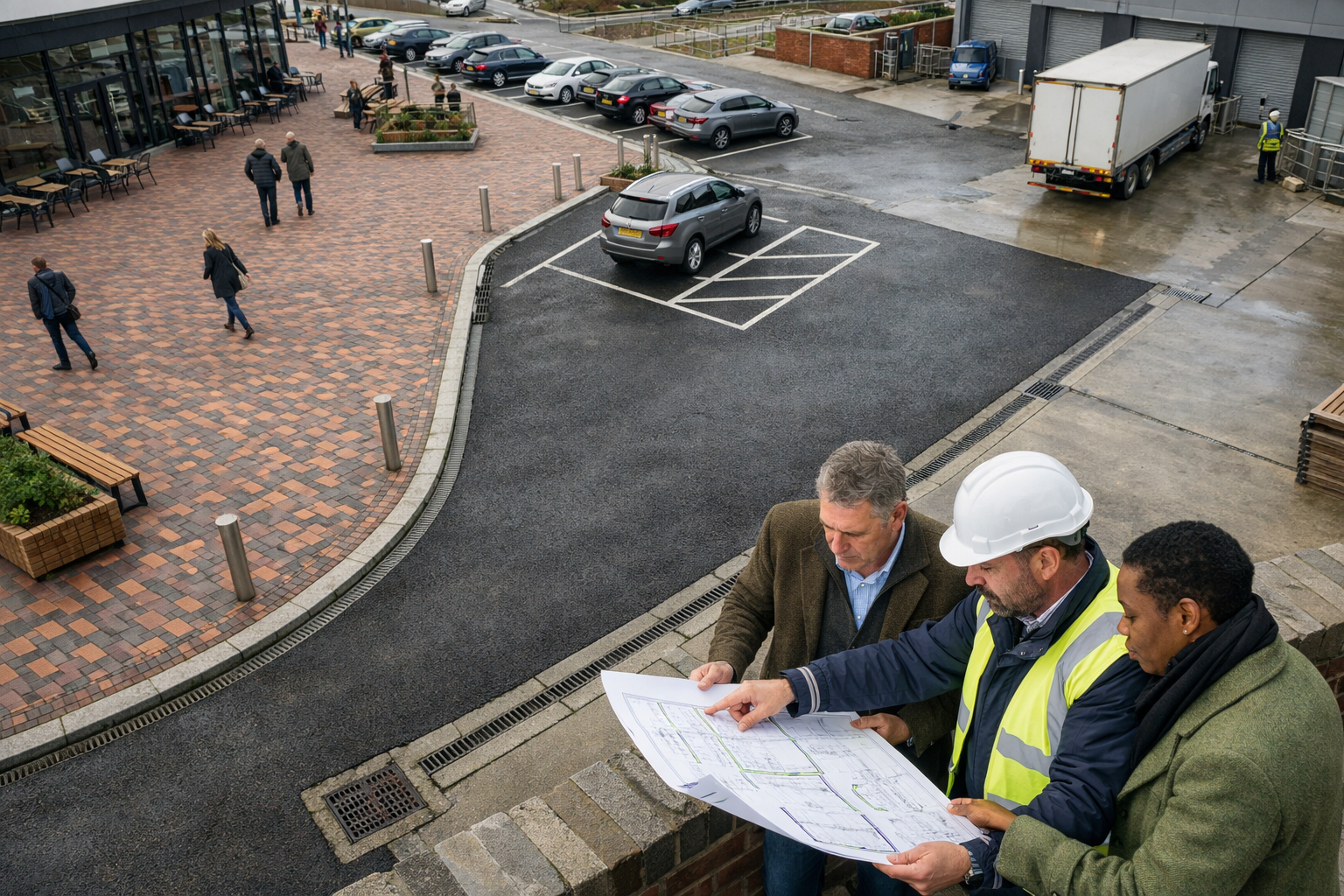
A good example is a business park entrance. We might specify asphalt for the main carriageway and parking bays, then use block paving for pedestrian crossings, threshold areas, and feature edges. That gives you durability where traffic is heaviest and a cleaner visual finish where people first arrive.
If your scheme includes public-facing routes, our footpaths and pedestrian paving services and commercial car park surfacing solutions cover both sides of that brief.
How do cost and programme compare for commercial block paving vs asphalt?
Asphalt usually wins on upfront cost and installation speed. Block paving often costs more initially, but it can make local repairs and later access easier. Budget decisions should look at whole-life use, not just day-one rates.
The research sources provided for this article show wide asphalt cost ranges, with commercial pricing influenced by thickness, loading, and project complexity. Some sources place commercial asphalt around $3 to $20 per square foot and general asphalt installation around $5 to $9 per square foot [2][3]. Those are non-UK figures, so use them only as directional context, not UK budget rates.
What matters more in the UK commercial market is what drives cost:
- Sub-base depth
- Traffic category
- Drainage requirements
- Kerbing and edgings
- Utility covers and ironwork
- Access constraints
- Phasing and traffic management
- Surface area and detailing
Why asphalt is usually faster
Asphalt is laid by machine and can cover large areas quickly. Commercial asphalt projects often run over several days to weeks depending on scale, but the laying process itself is generally faster than block paving [2].
Why block paving can cost more
Block paving is labour-intensive. It needs tighter setting out, edge restraint planning, cutting, and joint finishing. Detailed areas take time.
Whole-life cost questions to ask
- Will vehicles turn heavily in one spot?
- Will utility access be frequent?
- Does the site need a premium look?
- Is downtime more expensive than materials?
- Can you phase the work around tenants or operations?
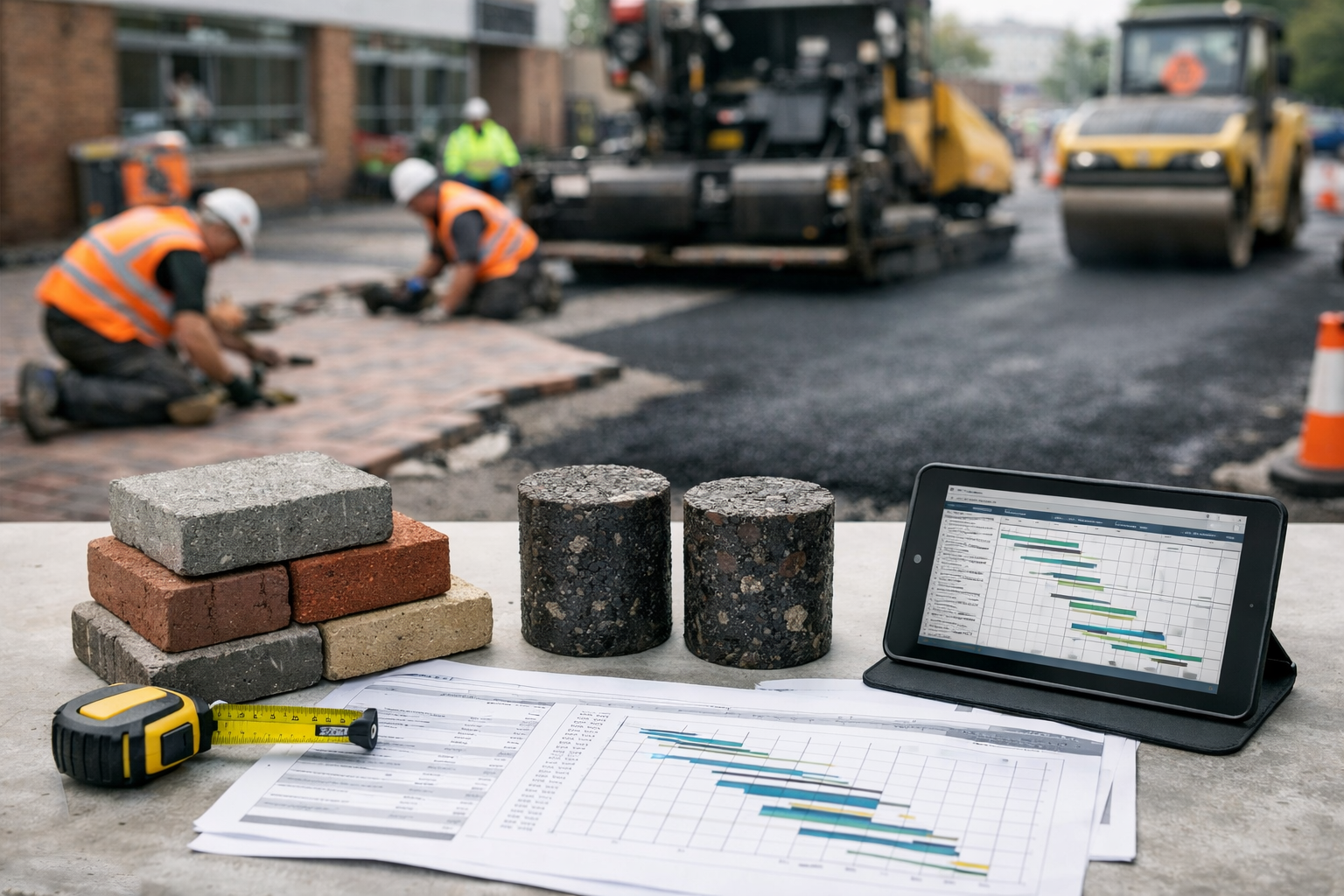
“The cheapest rate on tender can become the most expensive decision if it creates avoidable closures, patching, or rejected finishes later.”
Kerry Hopper, Finance Director, 18+ years
If programme pressure is the main issue, our team’s advanced paving capability is built around reducing delivery time on commercial schemes where access windows are tight.
Which option lasts longer and needs less maintenance?
Asphalt is easier and cheaper to repair in small ways, but it usually needs more frequent maintenance. Block paving can last well and allows localised reinstatement, but only if the base, edge restraints, and jointing are right.
Asphalt is durable and widely used because it handles traffic and weather well [5]. It is also skid-resistant, which supports vehicle traction [6]. But commercial asphalt often needs routine crack repairs and periodic maintenance because of heavier use [2].
Some provided sources suggest asphalt surfaces may last around 15 to 20 years, while harder paved surfaces can last longer in some applications [3][5]. Actual lifespan on a commercial site depends far more on design, drainage, and traffic loading than headline numbers.
Asphalt maintenance usually includes:
- Crack sealing
- Local patching
- Resurfacing overlays
- Repainting line markings
- Drainage and edge checks
Block paving maintenance usually includes:
- Re-sanding joints
- Replacing damaged units
- Weed and detritus control
- Reinstating settled local areas
- Cleaning and stain management
A common edge case is utility-heavy sites. If chambers, ducts, or drainage runs are likely to be accessed often, block paving can be useful because local areas can be lifted and reset more neatly than saw-cut and patched asphalt.
On the other hand, for large HGV areas, repeated turning stress can challenge modular surfaces if the design is not robust enough. In those cases, you may need a heavier-duty asphalt or even another solution entirely, such as industrial heavy-duty surfacing.
How do drainage, compliance and adoption affect the choice?
Drainage and approval requirements can change the best material choice fast. A commercial block paving vs asphalt comparison is not complete until you check SuDS, adoptable standards, utility access, and local authority expectations.
This is where many projects drift into delay.
Surface type affects:
- Water runoff behaviour
- Falls and level design
- Gully spacing
- Utility cover detailing
- Long-term maintenance responsibility
- Adoptable construction details
Block paving can support permeable design approaches in the right system. One source in the supplied research notes permeable pavers as a cost-effective commercial paving option in some contexts [4]. That may be relevant if your planning strategy prioritises runoff control and surface water management.
Asphalt can also sit within SuDS strategies, but the drainage design needs to be coordinated properly with channels, gullies, attenuation, and sub-base design.
Common mistake
Choosing a finish before reviewing adoption and drainage requirements.
If your roads may be offered for adoption, or if your site ties into broader highways works, review:
- Section 38 agreement guidance
- SuDS drainage adoption advice
- drainage installation and SuDS expertise
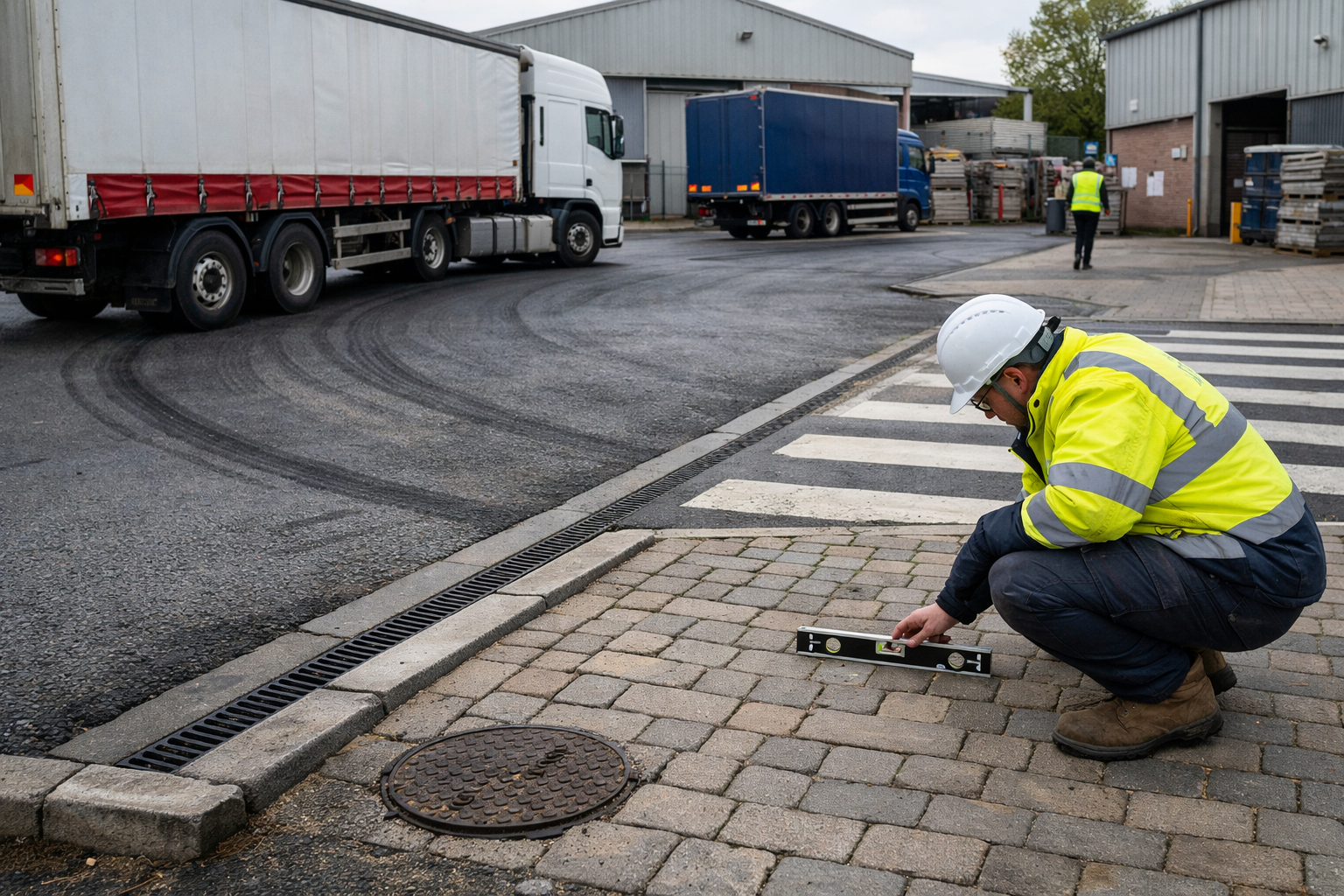
I’ve seen this happen on live schemes: the architect prefers block paving for the frontage road, the drainage engineer needs certain levels and access points, and the adopting authority wants a different standard detail. The answer is not to force one material. It’s to coordinate earlier.
“Most commercial surfacing problems don’t start on site. They start when design decisions are made in isolation.”
Tony Flook, Managing Director, 25+ years
Is block paving or asphalt better for appearance, branding and user experience?
Block paving usually looks better in front-of-house spaces. Asphalt usually looks cleaner and more practical in large vehicle areas. If public perception matters, surface finish plays a bigger role than many clients expect.
Block paving helps you create:
- Defined entrances
- Premium shared spaces
- Visual zoning
- Pedestrian priority cues
- Stronger architectural character
Asphalt helps you create:
- Clean, uniform circulation areas
- Practical parking layouts
- Fast reinstatement in working environments
- Cost-effective larger blacktop areas
For estates managers, this often comes down to where visitors actually notice the surface. Main entrance? Yes. Rear service road? Usually not.
A blended strategy often gives the best result:
- Asphalt in car park aisles and access roads
- Block paving at crossing points and front entrances
- Clear road markings and signage to support legibility
For projects where finish and function need to work together, signage and road marking installation is often just as important as the surface itself.
What is the best commercial block paving vs asphalt comparison for your site type?
The best choice depends on your site category. Here’s the practical version.
| Site type | Usually best choice | Why |
|---|---|---|
| Business park roads | Asphalt | Fast, durable, cost-effective over large areas |
| Retail frontage | Block paving | Better appearance and pedestrian feel |
| Commercial car park | Mostly asphalt | Efficient for bays and aisles, easier resurfacing |
| Office courtyard | Block paving | Higher design value and clear pedestrian priority |
| Industrial yard | Heavy-duty asphalt or specialist surfacing | Better for vehicle loads and turning stress |
| Mixed-use development | Combination | Match each zone to its real use |
Quick checklist before you specify
- Define vehicle types and turning loads.
- Confirm pedestrian priority areas.
- Review drainage and SuDS requirements.
- Check whether roads or spaces may be adopted.
- Decide where aesthetics genuinely matter.
- Compare whole-life maintenance, not just install cost.
- Coordinate utilities and future access points.
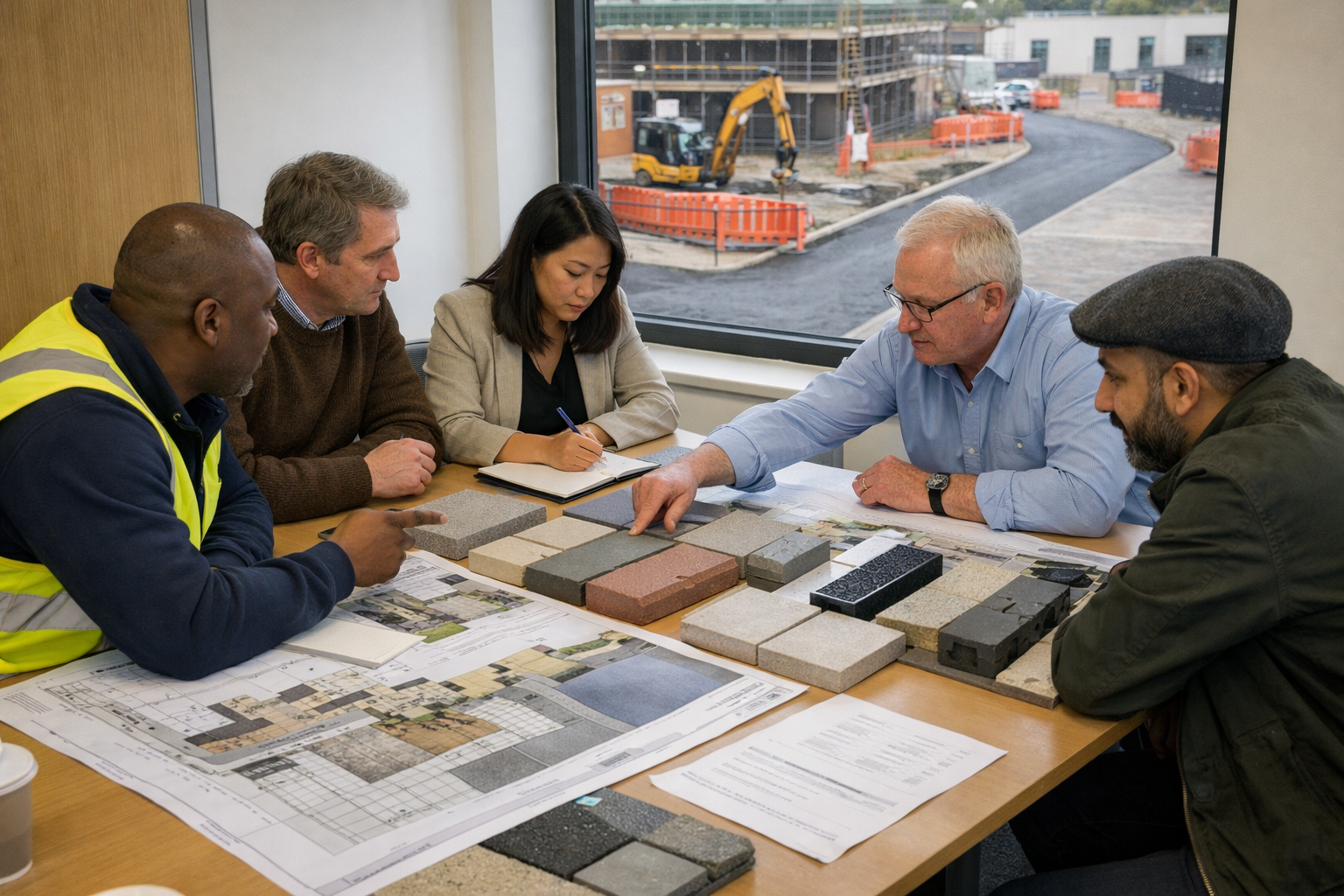
For broader advice on selecting the right build-up and specification, see our commercial surfacing advice and solutions and materials and specification advice.
FAQs
Is asphalt cheaper than block paving for commercial sites?
Usually, yes. Asphalt is generally cheaper to install over large commercial areas, especially where the layout is simple and the programme is tight [2][3].
Does block paving last longer than asphalt?
It can in the right application, but lifespan depends on design, drainage, traffic, and maintenance. Poorly designed block paving can fail early, just like poorly designed asphalt.
Which is better for HGV traffic, block paving or asphalt?
Asphalt is usually the safer default for HGV routes and large trafficked areas. For very heavy-duty operations, the best answer may be a specialist heavy-duty pavement rather than standard block paving or standard asphalt.
Can block paving be used in commercial car parks?
Yes, especially in feature zones, pedestrian crossings, and smaller parking areas. For larger car parks, many clients use asphalt for the main running surfaces and block paving only where detail is needed.
Is asphalt quicker to install on a live commercial site?
Usually, yes. Asphalt is widely chosen where access windows are short and disruption needs to be controlled because machine laying is faster over large areas [2][5].
What if my site needs both appearance and durability?
Use both materials in the right places. That is often the most effective outcome in a commercial block paving vs asphalt comparison.
Conclusion
For most estates managers, developers, and architects, the answer is straightforward: asphalt for scale and traffic, block paving for detail and presentation.
But the best specification is rarely based on material alone. It depends on loading, drainage, maintenance access, user experience, adoption risk, and programme pressure. That’s why the strongest schemes start with a site-led brief, not a favourite finish.
If you’re weighing up options now, take these next steps:
- Map your site by real use, not plan labels
- Separate vehicle zones from pedestrian zones
- Confirm drainage and adoption constraints early
- Compare whole-life cost, not only install cost
- Ask whether a blended solution gives you the best result
If you want a second opinion on your layout, build-up, or specification, Highways Plus can help you assess the practical trade-offs before they become costly site changes. Start with our commercial surfacing and civil engineering team or contact Highways Plus for project-specific advice.
References
[1] Residential Vs Commercial Asphalt Paving Key Differences You Should Know – https://mvppavingky.com/2025/05/residential-vs-commercial-asphalt-paving-key-differences-you-should-know/
[2] Commercial Vs Residential Asphalt Paving Key Differences Explained – https://blacktar.ca/commercial-vs-residential-asphalt-paving-key-differences-explained/
[3] Is An Asphalt Driveway Cheaper Than Concrete – https://www.modernyardz.com/blogs/is-an-asphalt-driveway-cheaper-than-concrete
[4] Commercial Paving – https://todayshomeowner.com/concrete/guides/commercial-paving/
[5] Understanding The Difference Between Asphalt And Brick Paving – https://www.asphalt.com.au/understanding-the-difference-between-asphalt-and-brick-paving/
[6] Asphalt Vs Pavement Understanding The Differences – https://www.leeboy.com/asphalt-vs-pavement-understanding-the-differences/
Meta title
Commercial block paving vs asphalt comparison guide
Meta description
Commercial block paving vs asphalt comparison for estates managers, developers and architects. Compare cost, durability, drainage and site suitability.
commercial surfacing, asphalt paving, block paving, commercial block paving vs asphalt comparison, car park surfacing, industrial yards, drainage design, SuDS, estate management, highway adoption, paving specification