Skip to content
Last updated: April 15, 2026
Quick Answer
Sustainable road construction and SuDS compliance now need to be planned together, not separately. In 2026, mandatory SuDS requirements and stronger national standards mean councils, developers, and ESG-led clients need roads that are adoptable, drain correctly, reduce environmental impact, and remain practical to maintain over the long term [1][3].
If you leave drainage, materials, or adoption strategy too late, you increase the risk of redesign, delay, and higher commuted sums. The best results come from integrating highways design, drainage design, maintenance planning, and carbon-conscious material choices from day one.
Key takeaways
- Sustainable road construction and SuDS compliance should be treated as one design problem, not two separate workstreams.
- Schedule 3 implementation in 2026 makes SuDS mandatory for new developments across England and Wales, with separate approval routes through SuDS Approving Bodies [1].
- The 2026 National SuDS Standards place more weight on runoff control, maintenance, biodiversity, and early approval before construction starts [3].
- Permeable surfaces and blue-green infrastructure are increasingly preferred where site conditions allow [2].
- Adoption success depends on build quality, maintainability, clear legal responsibilities, and authority-specific standards.
- Councils and developers should agree inspection, handover, and maintenance expectations early.
- Low-carbon materials only help if they still meet loading, durability, and whole-life performance needs.
- Common failure points include late drainage redesign, poor utility coordination, and unclear ownership of SuDS assets.
- A joined-up contractor can reduce friction between surfacing, civils, drainage, and adoption teams.
- Early technical reviews usually cost less than fixing defects after practical completion.
For more on low-carbon materials and build strategies, see our guide to sustainable road construction and our advice on highway drainage solutions and SuDS installation.
Why does sustainable road construction and SuDS compliance matter more in 2026?
It matters more in 2026 because drainage approval is getting stricter, flood resilience expectations are higher, and public bodies are under pressure to deliver environmental value as well as adoptable infrastructure. Roads can no longer be designed first and “drained later” without risk.
In practical terms, 2026 changes the sequence.
Schedule 3 of the Flood and Water Management Act is being implemented in 2026, making SuDS mandatory for new developments across England and Wales [1]. That means drainage is now treated more like essential infrastructure, with designated SuDS Approving Bodies reviewing schemes separately from planning permission [1].
What this changes for your project
- Design starts earlier: carriageway levels, verge widths, and drainage corridors need early agreement
- Approval routes increase: planning consent alone may not be enough
- Maintenance gets more scrutiny: adoptable assets must be practical to inspect and maintain
- Environmental targets become visible on site: biodiversity, runoff reduction, and material choices are harder to ignore
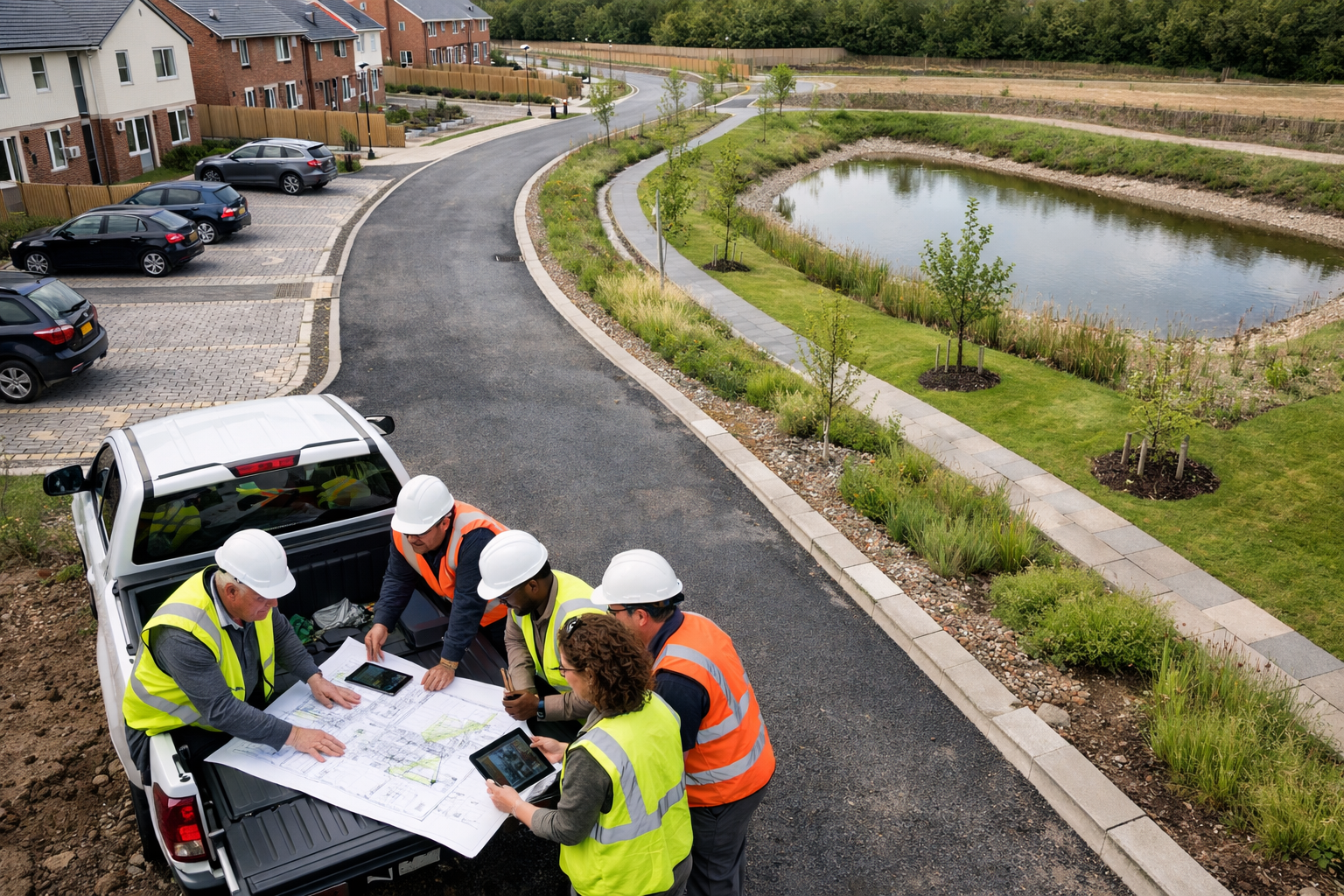
A council highways team may accept a road geometry layout, but the same scheme can still stall if the SuDS approach is underdeveloped. We see that tension often on mixed-use and residential sites.
“The projects that move fastest are usually the ones that stop treating drainage as a drawing package and start treating it as site infrastructure.”
Ben Sperring, Surfacing and Civils Manager
Quick decision rule:
Choose early integrated design if your project needs adoption, multiple approvals, or ESG reporting. It avoids expensive redesign later.
What counts as sustainable road construction and SuDS compliance?
Sustainable road construction and SuDS compliance means building roads that meet performance, safety, drainage, and adoption requirements while reducing flood risk and environmental impact. It combines material choices, pavement design, water management, maintenance planning, and legal adoption strategy.
That sounds broad, because it is.
For councils and developers, the core tests usually look like this:
| Area | What good looks like | Common mistake |
|---|---|---|
| Pavement design | Material and thickness suit traffic and ground conditions | Choosing low-carbon options without checking performance |
| Surface water management | Runoff controlled at source and through the network | Adding SuDS features after road levels are fixed |
| Adoption readiness | Layout, records, inspections, and legal agreements aligned | Assuming “build to spec” automatically means adoptable |
| Maintainability | Assets can be accessed, cleaned, repaired, and funded | Designing features nobody wants to own |
| Environmental outcomes | Biodiversity, water quality, and carbon considered | Focusing on one metric and ignoring whole-life cost |
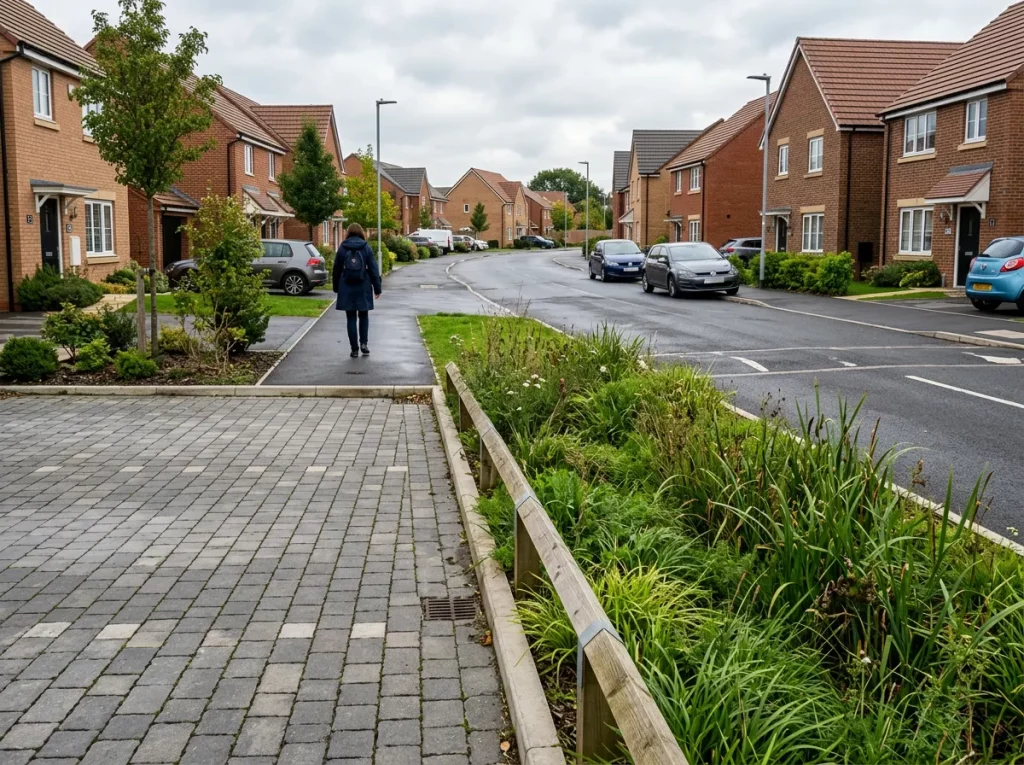
Nature-based or “blue-green” solutions such as rain gardens, swales, and planted depressions are increasingly favoured over purely engineered systems where site conditions allow [2]. At the same time, the updated 2026 standards place stronger emphasis on runoff rate and volume control, biodiversity, and maintenance planning [3].
If you’re shaping a new estate road or commercial access route, our civil engineering services from design to adoption and road construction, repair and resurfacing support can help you join up those moving parts early.
How do you design roads that meet adoption and environmental targets together?
You meet both targets by designing the road corridor as a single system. That means carriageway, verges, drainage, levels, utilities, maintenance access, and material specification are coordinated from concept stage.
This is where many schemes either become straightforward, or painful.
A practical 7-step checklist
Set the adoption route early
Confirm whether the road, drainage, or SuDS assets will be adopted and by whom. If Section 38 or Section 104 routes are likely, design with those requirements in mind from the start.Fix levels with drainage in view
Road levels, thresholds, and exceedance routes need to work together. Late changes often break the drainage logic.Choose the right SuDS tools for the site
Permeable paving, swales, filter drains, basins, rain gardens, and attenuation all have a place. Pick based on infiltration potential, contamination risk, land take, maintenance access, and authority preferences.Specify materials on whole-life value
Recycled content and lower-carbon mixes can be useful, but loading, durability, and maintenance frequency still matter.Plan utility corridors carefully
Utility conflicts are a quiet killer of good SuDS layouts.Agree inspection and evidence requirements
Build records, test results, as-builts, and photos save time later.Define maintenance ownership before handover
If nobody wants the asset, adoption gets harder.
🔧 Insider tip from site delivery
A permeable surface is not automatically a good SuDS solution. If sub-base contamination risk, trafficking, or maintenance access are wrong, another treatment train may be safer.

For adoption-specific planning, see our Section 38 agreement guide, Section 104 sewer adoption and drainage solutions, and SuDS drainage adoption guide for 2026 council approval.
Which materials and SuDS features work best for sustainable road construction and SuDS compliance?
The best choice depends on traffic loading, ground conditions, contamination risk, available land, and who will maintain the asset. There is no single “greenest” option that works everywhere.
That said, some combinations work well more often than others.
🌿 Common choices and where they fit
Permeable paving
- Useful for parking courts, low-speed areas, and some lightly trafficked routes
- Supports source control
- Needs careful detailing, clean stone layers, and maintenance access
- New hardstanding and parking areas are expected to be permeable in many 2026 scenarios [2]
Swales and filter drains
- Good along verges and road edges
- Help with water quality and visible environmental value
- Need enough space and sensible outfall strategy
Rain gardens and planted depressions
- Strong option where placemaking and biodiversity matter
- Popular with planning teams looking for blue-green infrastructure [2]
- Need robust planting design and clear maintenance responsibility
Attenuation basins and ponds
- Effective for larger sites
- Good when land is available
- Need safety, access, and lifecycle maintenance planning
Low-carbon asphalt and recycled aggregates
- Can reduce embodied carbon when correctly specified
- Best where performance data, supply chain quality, and programme are reliable

“Cost control in civil engineering is rarely about the cheapest line item. It’s about avoiding redesign, delay, and assets that cost more to maintain than they saved to build.”
Kerry Hopper, Finance Director
Choose X if…
- Choose permeable paving if traffic is moderate, maintenance is understood, and infiltration or storage design is suitable.
- Choose swales or rain gardens if you need visible environmental gains and have verge or public realm space.
- Choose traditional piped systems with above-ground SuDS support if loading, contamination, or authority requirements limit infiltration.
For more on specifications, browse our materials and specification advice and drainage installation and SuDS expertise.
What usually stops road adoption when SuDS are involved?
Most adoption problems come from unclear ownership, poor build quality, missing evidence, or designs that are technically compliant on paper but impractical to maintain. In short, the details catch up with you.
We’ve seen the same issues repeat.
⚠️ Five common blockers
Late-stage SuDS redesign
The road layout is fixed, but the drainage route no longer works.Authority mismatch
Planning, highway, and drainage teams want different things, and nobody resolves the conflict early.Poor construction tolerance
Small level errors can stop water flowing to the right place.Unclear maintenance responsibility
If future ownership is vague, adoption discussions drag on.Incomplete handover records
Missing as-builts, test certificates, or inspections create avoidable disputes.
A developer recently asked us to review a site where standing water kept appearing along a new carriageway edge. The issue was not one big design failure. It was three small ones: kerb upstands varied, a chamber invert was slightly off, and the maintenance team had no clear record of the intended flow path. Fixing those defects after surfacing cost far more than checking them properly during the works.
If your scheme is already stuck, our guides on the adoption crisis and hidden delays, backlog defect resolution and adoption management, and commuted sums explained are useful next reads.
How can councils, developers, and ESG-led clients reduce cost and programme risk?
The simplest answer is early coordination. Bring highways, drainage, surfacing, legal adoption, and maintenance thinking into one conversation before detailed design is locked.
That sounds obvious, but it’s still where projects slip.
💬 What better coordination looks like
- Hold a pre-design workshop with highways, drainage, and adoption stakeholders
- Map likely approval routes before planning is submitted
- Test maintenance practicality, not just hydraulic performance
- Review commuted sum exposure early
- Ask for construction-stage quality checks at hold points, not only at the end
- Use as-built capture consistently, with photos and surveyed records
The 2026 standards also require stronger maintenance planning and mandatory SAB approval before construction in relevant cases [3]. That means programme risk is now tied more closely to paperwork, approvals, and long-term asset logic, not only physical construction.
“Clients usually come to us because the technical issue looks complicated. Most of the time, the commercial risk is the bigger problem. If you solve that early, the engineering becomes much easier to manage.”
Tony Flook, Managing Director
For schemes with live interfaces, our highway adoption advice and contact page are the best place to start a practical review.
What does a good delivery model look like in practice?
A good delivery model joins design intent to on-site reality. It uses one clear chain of responsibility for surfacing, civils, drainage interfaces, and handover evidence, even if multiple specialists are involved.
That matters because the road does not fail in neat professional silos.
🛠 A workable project model
- Concept stage: agree adoption route, SuDS hierarchy, authority expectations
- Design stage: coordinate levels, pavement build-up, drainage, utilities
- Pre-start stage: lock specifications, QA plan, inspection points, records
- Construction stage: inspect levels, drainage interfaces, material compliance
- Handover stage: complete as-builts, tests, O&M information, defect plan
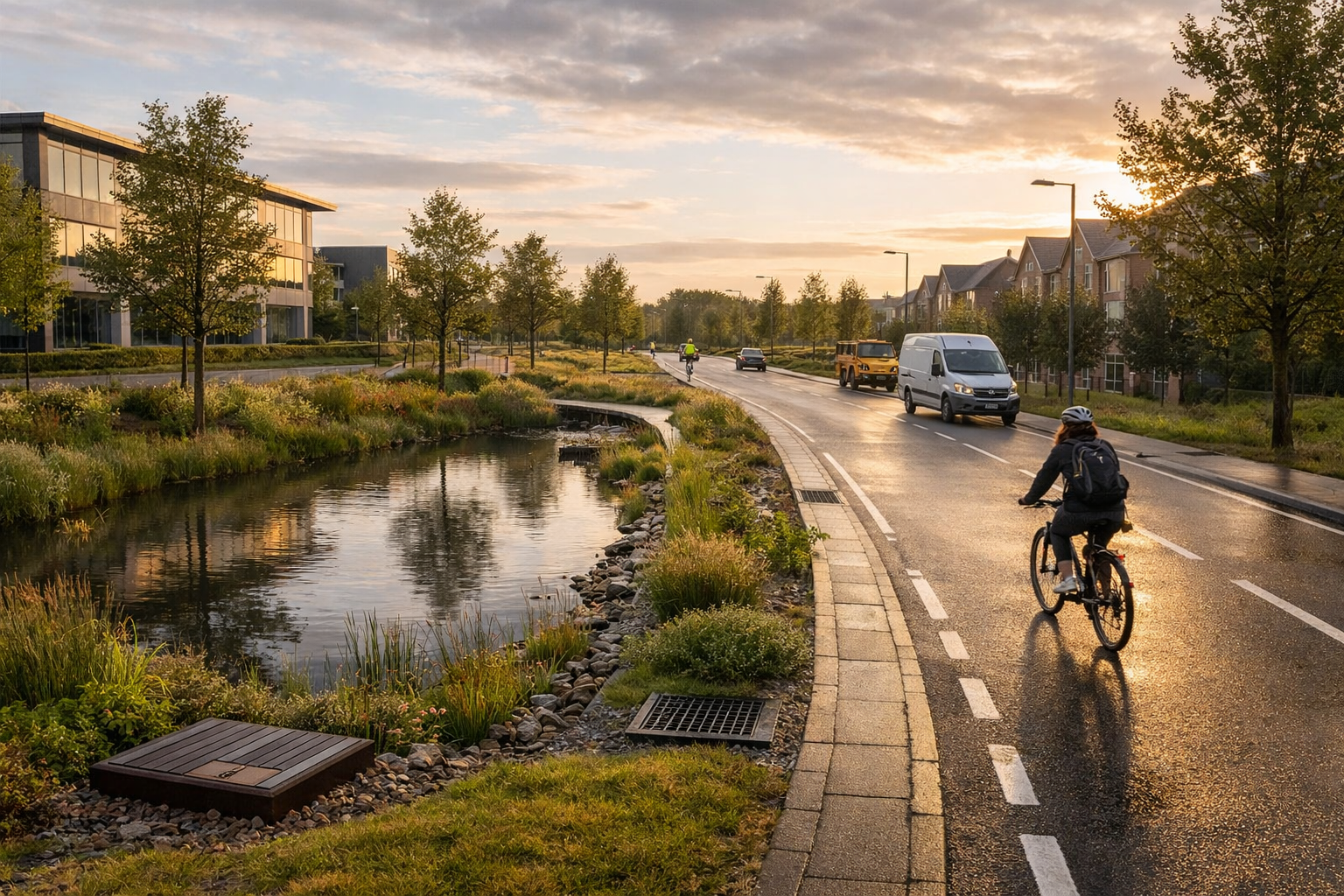
Mike Clancy, Non-Executive Director, often puts it plainly:
“Operationally strong projects are not the ones with the most meetings. They are the ones where decisions are made at the right time, by the right people, with the cost implications understood.”
That’s the value of working with a partner who understands both compliance and delivery. You can learn more about Highways Plus and our wider surfacing and civil engineering services.
FAQs
Is SuDS approval now separate from planning permission?
In relevant 2026 cases, yes. SuDS Approving Bodies review drainage proposals separately, which means planning progress does not remove the need for proper SuDS approval [1].
Are permeable surfaces mandatory on all new roads?
Not on every road in every context, but permeable surfaces are increasingly expected for new driveways, parking areas, and hardstanding where site conditions allow [2]. Final design still depends on traffic, contamination, maintenance, and authority requirements.
Can low-carbon materials affect adoption?
Yes, if they are poorly specified or unsupported by performance evidence. Adoption authorities will still expect durability, structural performance, and maintainability, not just lower embodied carbon.
Who should maintain SuDS features after completion?
That depends on the legal and adoption structure. The key point is to define ownership, access, and maintenance obligations before handover, otherwise delays are likely.
What is the biggest mistake developers make with sustainable road construction and SuDS compliance?
The biggest mistake is leaving drainage and adoption strategy too late. When road levels, utility routes, and public realm layouts are already fixed, SuDS options shrink fast.
Does blue-green infrastructure help with ESG reporting?
Usually yes, because visible SuDS features can support flood resilience, biodiversity, amenity, and placemaking goals. They still need to be practical to maintain and acceptable to adopting bodies.
Conclusion
Sustainable road construction and SuDS compliance are now central to getting roads adopted, controlling flood risk, and meeting environmental expectations in 2026. The projects that perform best are the ones that align design, approvals, materials, maintenance, and delivery from the start.
If you’re a council, developer, or ESG-driven client, the next step is simple: review your scheme early, confirm who will adopt what, and test whether your road and drainage strategy really work together in practice.
At Highways Plus, that’s where we add the most value, translating complex compliance into buildable, adoptable, commercially sensible solutions.
References
[1] Suds In 2026 How Sustainable Drainage Design Is Changing For Homeowners Architects Developers – https://www.sudsdesigns.co.uk/post/suds-in-2026-how-sustainable-drainage-design-is-changing-for-homeowners-architects-developers
[2] Flood Risk Suds 2026 Sequential Test Guide – https://www.sovatechconsulting.com/insights/flood-risk-suds-2026-sequential-test-guide
[3] 2026 National Suds Standards – https://www.sudsdesigns.co.uk/2026-national-suds-standards
Related reading