Skip to content
Last updated: March 11, 2026
Quick Answer
A practical highway adoption backlog solution starts with a forensic site audit, then a clear defect schedule, realistic cost plan, authority engagement, and a tightly managed remedial works programme. If you want bond release, you need to solve the technical defects, the paperwork gaps, and the communication failures at the same time.
Many legacy schemes stall because nobody owns the full path from old Section 38 issues to final sign-off. The fix is simple in principle, but disciplined in delivery.
Key takeaways
- Start with a full audit of the road, drainage, lighting, signs, drawings, agreements, and bond status
- Separate construction defects from document defects early
- Confirm whether the live blocker is technical non-compliance, missing records, or authority capacity
- Build a defect schedule with priorities, cost ranges, and sign-off criteria
- Re-engage the highway authority with one coordinated plan, not piecemeal emails
- Check linked adoption issues such as drainage and SuDS before resurfacing
- Use phased remedial works if cash flow or occupation pressures are tight
- Keep legal, commercial, and site teams aligned on the same evidence pack
- Bond release usually follows successful works, inspections, maintenance period close-out, and formal certification
- A good highway adoption backlog solution reduces risk, improves sales progression, and removes balance sheet drag
A legacy adoption backlog rarely starts with one big failure. It usually grows from years of small ones, missed inspections, contractor changes, expired contacts, and incomplete records. If that sounds familiar, you’re not alone.
At Highways Plus, we often see developers inherit roads that are technically close to completion but commercially stuck. The gap between those two things is where projects sit for years.
What is a highway adoption backlog solution, and who actually needs one?
A highway adoption backlog solution is a structured process for moving delayed or historic Section 38 roads from uncertainty to adoption readiness and bond release. It is most useful for developers, insolvency teams, consultants, and legal advisers dealing with partially completed or long-delayed estates.
Typical cases include:
- Roads built years ago but never signed off
- Estates with expired or unclear Section 38 obligations
- Developments where the original contractor is gone
- Schemes with disputed defects or missing as-builts
- Sites where home sales or refinancing are affected by non-adopted roads
Choose a full backlog strategy if the site has been dormant, records are incomplete, or several issues overlap.
Choose a lighter-touch review if the road is built, the paperwork is mostly intact, and only final defects remain.
“Most backlog cases aren’t blocked by one defect. They’re blocked by a chain of small unresolved issues that no one has pulled into one plan.”
Tony Flook, Managing Director, Highways Plus
For background, our guide to backlog defect resolution and adoption management explains why these schemes stall and how to regain control.
How do you audit a legacy site properly?
Start with a site audit that covers physical condition, legal paperwork, and authority history. A legacy road audit is not just a walk-round with a snagging list.
The audit should answer five questions:
- What was meant to be adopted?
- What was actually built?
- What condition is it in now?
- What evidence is missing?
- What does the authority still need to sign off?
🔍 What to include in the audit
- Section 38 agreement and approved drawings
- Bond details and current bond holder status
- Previous inspection records and defect notices
- Surfacing, kerbs, footways, signs, lighting, drainage, and visibility splays
- Ironwork levels, gully condition, and outfalls
- As-built drawings, test results, and material records
- Sewer and SuDS interface issues
- Any occupation, traffic loading, or third-party damage since original construction

A common mistake is auditing only visible surfacing issues. In practice, hidden blockers often sit in drainage records, missing test certificates, or unresolved sewer adoption items. If drainage is part of the problem, it helps to review Section 104 sewer adoption and drainage solutions and the SuDS drainage adoption guide.
Quick example
We’ve seen roads where the wearing course looked tired but acceptable. The real delay was a lack of approved lighting records and no evidence of drainage cleansing before handover. Without those, final inspection never moved.
Action takeaway: Build one audit file with photos, marked-up drawings, defect logs, and approval history. If it isn’t in the file, assume you may need to prove it later.
What usually causes a legacy adoption backlog?
Most legacy cases are caused by a mix of technical defects, incomplete records, and unclear accountability. The longer the delay, the more these issues feed each other.
The most common root causes are:
- Final surfacing never completed
- Defects identified but never closed out
- Highway and drainage interfaces left unresolved
- Utility reinstatement damage after practical completion
- Missing test certificates or as-built information
- Contractor insolvency or supply chain disputes
- Bond ownership or surety queries
- Authority officer changes and fragmented correspondence
🧩 The three types of blockers
1. Physical blockers
Examples include failed surfacing, rocking kerbs, damaged footways, standing water, poor line marking, or non-compliant signage.
2. Documentary blockers
Examples include missing approval drawings, absent material compliance records, no CCTV, no levels, or unsigned inspection notes.
3. Process blockers
Examples include no live contact at the authority, unclear liability, phased works never regularised, or maintenance periods never formally started.
If you need a quick sense check, the Backlog Defect Calculator can help frame likely defect categories before you commit to works.
“The site team often sees the physical problem first. The legal team often sees the paper problem first. You clear the backlog faster when both are reviewed together.”
Mike Clancy, Non-Executive Director, Highways Plus
How do you build a highway adoption backlog solution plan that the authority will engage with?
The best way is to present one coordinated recovery plan with scope, costs, sequence, and requested decisions. Highway authorities respond better to a complete route to adoption than to drip-fed queries.
A workable recovery plan should include:
- A summary of the current adoption position
- A defect schedule, split by severity and responsibility
- Drawings showing what is in and out of scope
- A costed remedial works plan
- Any drainage or utility dependencies
- Proposed inspection points
- A request for confirmation of sign-off criteria
- A target route to maintenance and bond release
🛠️ A simple decision rule
Choose phased remediation if:
- The estate is live and occupied
- Cash flow is constrained
- Some assets can be signed off ahead of others
Choose one full package if:
- Traffic management can be planned efficiently
- The authority prefers one final inspection route
- The defects overlap and rework risk is high
The article on Section 38 agreements and new road adoption is useful if the original obligations need to be rechecked. If timing is your biggest issue, our Section 38 adoption timeline guide shows how programme compression is possible when the sequence is tightened.

Mini checklist: what authorities usually want to see
| Item | Why it matters |
|---|---|
| Approved or agreed drawings | Confirms the adoption baseline |
| Clear defect list | Prevents scope drift |
| Evidence pack | Supports inspection decisions |
| Named delivery lead | Gives one point of accountability |
| Inspection programme | Helps authority resource planning |
| Proposed completion route | Speeds agreement on next steps |
Action takeaway: Don’t ask, “What do you want from us?” Ask, “Here is the route to close-out, please confirm any additions.” It changes the conversation.
What remedial works usually unlock adoption fastest?
The quickest wins usually come from fixing critical safety, drainage, and compliance defects first. Cosmetic repairs matter, but they rarely unlock sign-off on their own.
Common high-impact remedial works include:
- Resetting ironwork to correct level
- Local carriageway reconstruction where settlement has occurred
- Final surface course application
- Gully, carrier drain, and outfall cleaning or repair
- Kerb realignment and edging repairs
- Footway and tactile paving corrections
- Signage, bollards, and road marking completion
- Street lighting certification and reinstatement
🚧 Where sequencing goes wrong
A common mistake is resurfacing before drainage and ironwork issues are closed. That creates abortive work and weakens your commercial position.
Ben Sperring, Surfacing and Civils Manager, often makes the point plainly:
“If chambers, drainage, and edge restraints aren’t right, laying the final surface early just stores up another defect.”
If the works package is broader than snagging, it may need support from civil engineering services from design to adoption or targeted road construction, repair and resurfacing support. For final compliance items, signage and road marking installation often becomes the difference between “nearly there” and “inspection ready”.
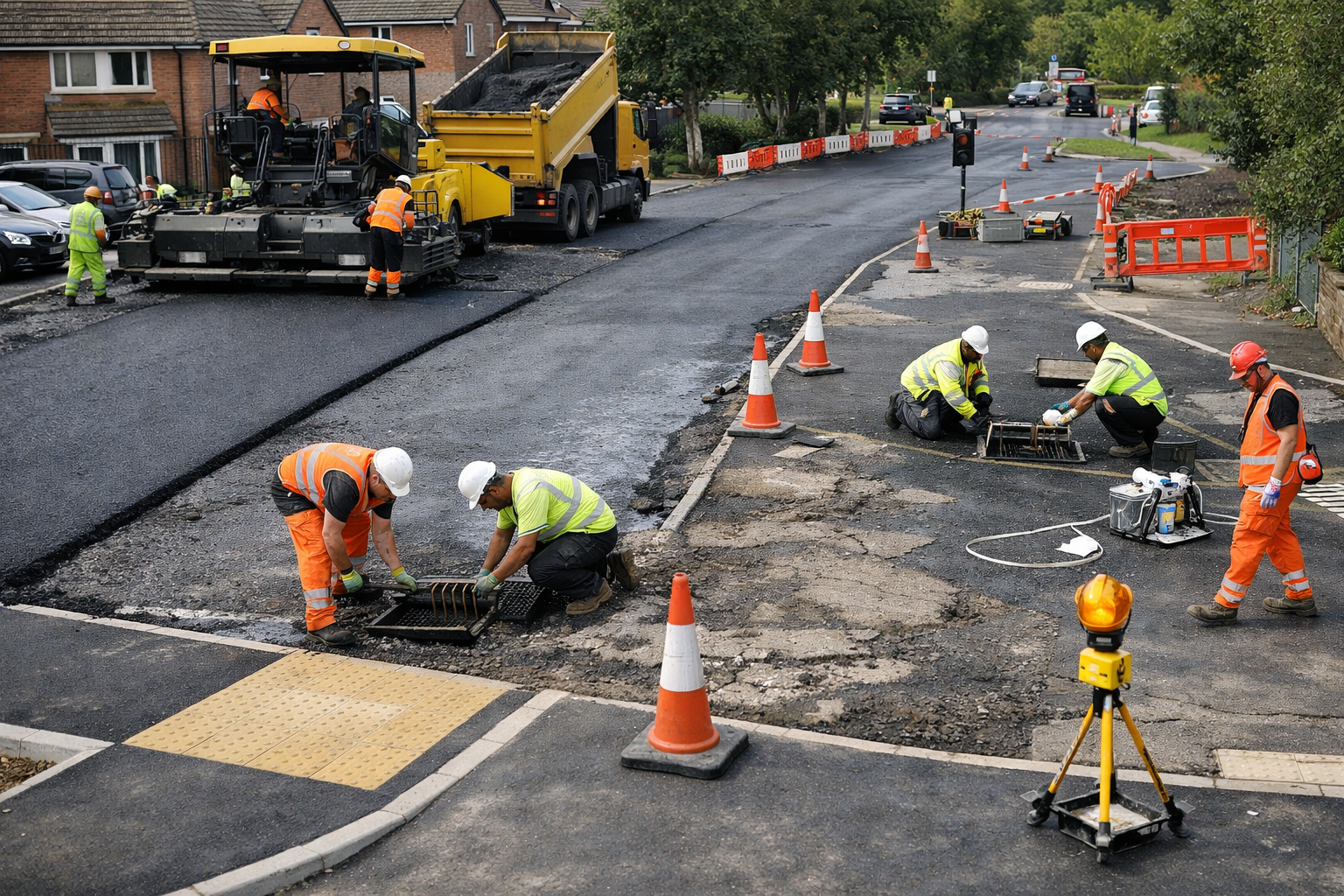
A practical sequencing order
- Confirm scope and authority hold points
- Resolve drainage and underground defects
- Correct levels, kerbs, ironwork, and edges
- Complete binder and surface course where required
- Install signs, lining, and street furniture
- Clean, test, and evidence everything
- Request joint inspection
Action takeaway: Always programme evidence gathering alongside physical works. Photos, delivery tickets, test records, and red-line as-builts are part of the job, not admin after the fact.
How do cost, bond exposure, and commuted sums affect the solution?
Legacy adoption decisions are commercial as much as technical. The right highway adoption backlog solution balances remedial cost against bond risk, delay cost, and wider project exposure.
You should compare:
- Estimated defect remediation cost
- Bond value and likelihood of call-in
- Ongoing maintenance liability
- Sales and legal friction from unadopted roads
- Potential commuted sums or additional authority requirements
- Professional fees and management time
💷 Where clients often lose money
They focus only on the repair bill.
Kerry Hopper, Finance Director, puts it well:
“An unresolved bond can sit quietly in the background, but it still affects cash flow, reporting, and risk. The cheapest construction fix isn’t always the cheapest business decision.”
If commuted sums are in play, read Commuted Sums Explained and, where appropriate, commuted sums negotiation and reduction. On some schemes, negotiated clarity can save more than shaving a few items off the works scope.
Common edge case
If the estate has been open to traffic for years, some defects may now reflect wear, third-party damage, or utility reinstatements rather than original construction failings. Responsibility can be more nuanced than the old defect list suggests.
Action takeaway: Build a side-by-side options paper. Option A, full remediation now. Option B, phased close-out. Option C, negotiated settlement. Then test each against cost, time, and legal risk.
How do you get from final inspection to bond release?
Bond release usually follows successful remedial works, authority inspection, close-out of outstanding evidence, and expiry or completion of any maintenance obligations. It is rarely automatic.
The final stage typically includes:
- Joint inspection and updated snag list
- Closure of any minor residual items
- Submission of completion records
- Confirmation of maintenance period status
- Final inspection after maintenance, if required
- Authority certificate or formal adoption step
- Bond reduction or release request

✅ What to check before asking for release
- Is every defect formally closed, not just physically repaired?
- Are as-builts complete and accepted?
- Are drainage, lighting, and signs all included?
- Has the maintenance period started, or merely been discussed?
- Is the bond held against the correct scope and value?
A lot of delay happens because teams ask for bond release too early. That creates another round of queries and slows trust.
For a broader view of recurring delay patterns, see The Adoption Crisis: Delays and Costs You Need to Know.
Action takeaway: Treat bond release as its own workstream. Give one person ownership of evidence, correspondence, and follow-up dates.
What mistakes keep adoption backlogs alive for years?
The main mistakes are fragmented ownership, incomplete evidence, and remedial works done without authority alignment. Even good contractors can get stuck if the close-out process is weak.
Common mistakes to avoid
- Repairing visible defects before confirming agreed scope
- Ignoring drainage or sewer adoption dependencies
- Assuming old drawings still match what was built
- Relying on historic email chains instead of a live action plan
- Sending legal, technical, and commercial messages separately
- Underpricing the enabling works and traffic management needed for return visits
📌 A better approach
Create one recovery file, one lead consultant or manager, and one agreed sequence. Then brief every party against that same plan.
If you need wider context, the Highways Plus advice hub is useful for related S38, S278, and compliance issues.
FAQ
How long does it take to clear a legacy highway adoption backlog?
It depends on the defect scale, authority responsiveness, and how complete the records are. Straightforward cases may move in months, while multi-issue historic schemes can take much longer if drainage, bond, or legal issues are unresolved.
Can you get bond release before full adoption?
Sometimes a bond can be reduced in stages, but full release usually depends on agreed completion and any maintenance obligations being satisfied. You need the authority’s written confirmation, not assumptions based on site progress.
Who should lead a highway adoption backlog solution?
The best lead is usually a technically strong project manager or consultant with authority-facing experience, supported by legal and commercial input. If no one owns the whole process, the backlog tends to drift.
What if the original contractor no longer exists?
You can still recover the scheme, but you’ll need a fresh audit, a new liability view, and often a revised remedial works package. Missing records become a bigger issue, so evidence gathering is critical.
Do drainage and SuDS issues stop road adoption?
Yes, they often do. If drainage performance, maintenance responsibility, or adoption interfaces are unclear, highway sign-off can stall even when the carriageway looks complete.
Is it worth fixing a backlog on a nearly sold-out site?
Usually, yes, if the unadopted status is still affecting legal completions, maintenance liability, bond exposure, or future land value. The right answer depends on the cost-to-risk ratio, not just the remaining house sales.
Conclusion
A legacy road backlog is rarely fixed by one inspection or one patch repair. A reliable highway adoption backlog solution starts with a hard-nosed audit, then moves through coordinated defect resolution, authority engagement, compliant remedial works, and disciplined close-out to bond release.
If you’re dealing with stalled adoption, start by answering three things this week:
- What is physically wrong?
- What proof is missing?
- What does the authority need to say yes?
That gives you a route forward.
And once you have a route, momentum follows.
If you want a practical second opinion on backlog defects, authority strategy, or remedial delivery, Highways Plus brings together surfacing, civils, and adoption experience in one place. You can learn more about the team on the Highways Plus about page or contact Highways Plus for a conversation about your scheme.