Skip to content
A higher‑spec, correctly engineered HGV yard in Avonmouth almost always outperforms a budget resurfacing on total cost of ownership. When you factor axle loads, turning shear, drainage, fuel resistance, and downtime risk, premium mixes and heavier pavement build‑ups can extend service life by 40–60%, reduce annual repair spend by 25–35%, and cut unplanned shutdowns. Pay a little more for Industrial yard resurfacing today to stop paying for years.
What you really buy with yard resurfacing (and why upfront price misleads)
You are not buying tarmac. You are buying uptime. Safer manoeuvring for reach‑stackers, predictable bearing for racking and cranes, fewer shut gates, and calmer insurers. A thin, “roads‑spec” overlay on a port yard often looks fine for a season, then fails under slow, tight turning. The result: potholes at container stack corners, ravelling on forklift paths, settlement around gullies, and reactive repairs that keep creeping into the programme.
Key idea: moving from cheapest‑acceptable to purpose‑designed heavy‑duty pavement typically shifts cost from reactive maintenance into lifespan.
“If it turns slow and heavy, it needs a different pavement.” — Highways Plus, Surfacing & Civils Team
The operational context at Avonmouth docks
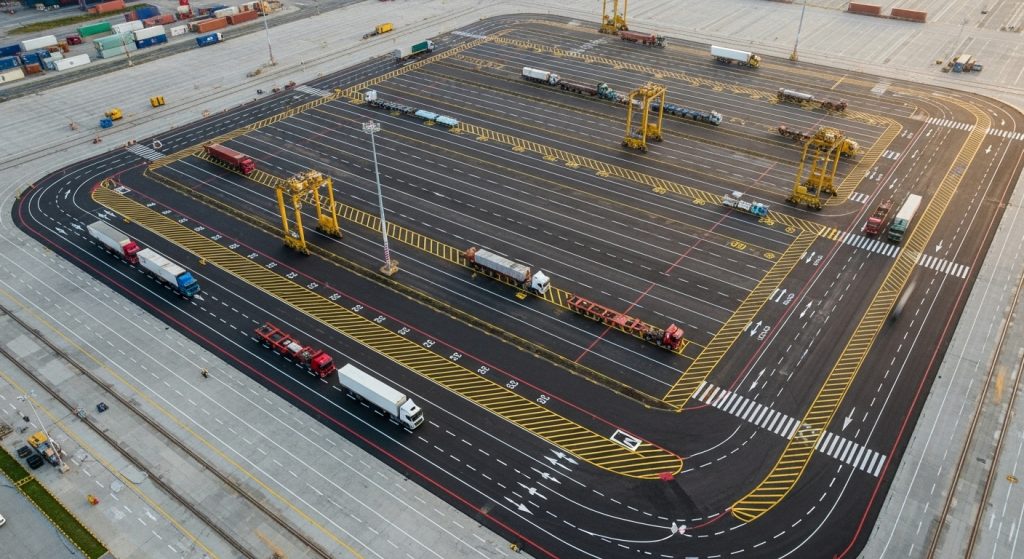
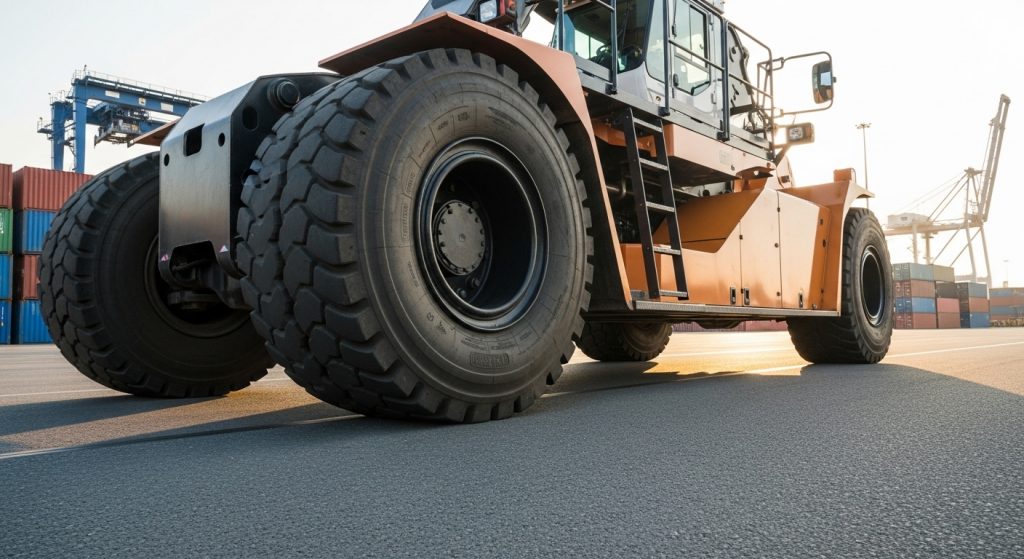
Slow manoeuvres, high static loads, and repetitive wheel paths dominate: reach‑stackers at 70–90 tonnes gross, articulated HGVs at 44 tonnes, forklifts with hard tyres, and tug routes with constant turning. Add salt‑air exposure, fuel and hydraulic spills, and drainage demands in flat aprons. Any specification must handle shear, point loading, and chemicals, not just simple axle repetitions.
Whole‑life cost: what actually drives it?
Seven levers decide your total cost of ownership (TCO):
- Traffic spectrum & turning intensity – ESALs are a start, but port yards fail from low‑speed shear. Design for turning circles and stack corners, not just through‑lanes.
- Sub‑grade strength & frost susceptibility – CBR testing, treatment where CBR < 5%, and separation membranes where required.
- Foundation & base stiffness – CBGM or hydraulically bound bases resist rutting and creep; thickness matters more than surface grade alone.
- Surface course mix & binder – High‑modulus base + polymer‑modified binder (PMB) or heavy‑duty HRA/SMA reduces shear damage and fretting.
- Detailing at “hot spots” – transitions at gullies, loading bays, and tight radii need extra thickness, smaller nominal aggregate, and edge restraint.
- Drainage & fuel resistance – sealed surfaces, correct falls, fuel‑resistant binders, and protected joints stop rapid ravelling.
- Planned maintenance windows – specifying surfaces you can patch overnight under traffic management keeps revenue gates open.
Spec options compared: upfront vs lifetime
Assumptions: 20,000 m² intermodal yard, mixed HGV/RS/forklift traffic, 20‑year view, typical South‑West ground conditions.
| Option | Build‑up (illustrative) | Typical upfront cost (£/m²) | Expected service life | Planned maintenance | Whole‑life notes |
| A. Thin overlay (budget) | 40 mm 10 mm SMA over unknown legacy base | 26–34 | 2–5 years in turn zones | Frequent patching from year 2 | Lowest capex; highest downtime risk; often false economy. |
| B. Roads‑spec deep asphalt | 40 mm 10 mm SMA + 60 mm HD binder + 200 mm dense base | 48–62 | 7–10 years | Annual joints/seal, localised patching | Works for through‑routes; struggles at stack corners. |
| C. Heavy‑duty asphalt with PMB | 50 mm HRA/SMA PMB + 80 mm EME2/HD binder + 220–260 mm base | 62–78 | 12–16 years | Planned surface renewal at year 12–14 | Strong shear performance; good fuel resistance options. |
| D. Asphalt on CBGM foundation | 40–50 mm PMB surface + 80 mm HD binder + 200–250 mm base over 200–300 mm CBGM | 72–92 | 15–20 years | Surface renewal at year 12–15 | Excellent rut resistance; best balance of cost and uptime. |
| E. Jointed concrete pavement | 200–250 mm PQC on 150–200 mm CBGM | 90–120 | 20–30 years | Joint sealing, occasional slab repair | Highest capex; superb static load capacity; careful joint detailing needed. |
Rule of thumb: moving from B → D typically adds 20–35% to capex but extends life 40–60% and cuts emergency repairs by 60–80%. For busy gates, that maths is compelling.
Where yards fail (and how to stop it)
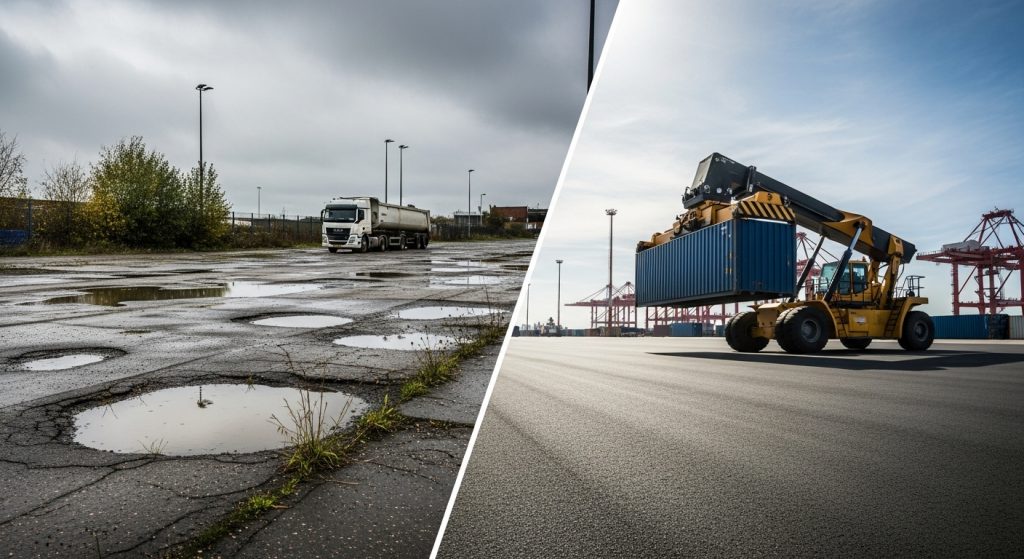
- Tight‑radius tear at container stack corners → increase surface thickness, specify PMB, tighten gradation, and add local reinforcement.
- Rutting in forklift lanes → stiffer base layers (EME2/CBGM) and thicker surface course; avoid open‑graded mixes here.
- Ravelling from fuel/hydraulic spills → fuel‑resistant binders, sealed joints, and spill response plan; consider thin epoxy seal at fuelling points.
- Settlement at gullies/covers → proper frame bedding, concrete collars, and compaction control around chambers.
- Ponding/ice on flat aprons → set minimum 1:80–1:60 falls; check as‑built with laser; keep slot drains clear.
Avonmouth‑ready specification blueprint (illustrative)
Heavy‑duty asphalt on CBGM foundation (Option D)
- Surface: 50 mm PMB HRA or SMA, high stone content, fuel‑resistant binder in identified spill zones.
- Binder: 80 mm high‑modulus/EME2 binder course for shear resistance.
- Base: 230 mm dense base course.
- Foundation: 250 mm CBGM (C8/10 – C12/15 range) over capping to achieve target stiffness.
- Geotextile separator where CBR < 5% and groundwater risk present.
- Detailing: +20 mm surface thickening within 8–12 m of stack corners and at tug turning loops; concrete collars at all frames.
- Drainage: minimum 1:80 falls; slot drains aligned with wheel paths; Grade A covers; fuel interceptor strategy.
- QA: nuclear density/voids testing; binder recovery checks for PMB compliance; as‑built laser survey for falls verification.
Why it works here: balances capex and uptime, handles slow turning shear, controls rut risk, and enables planned, overnight surface renewals with minimal closures.
Downtime economics: the hidden line on your P&L
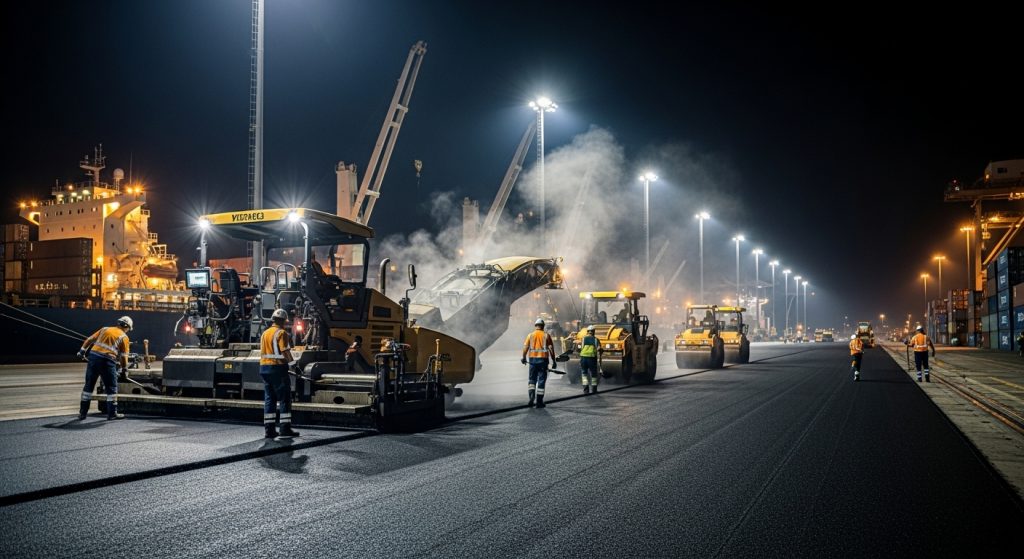
A single day of lost gate throughput can dwarf the saving from a cheaper mix. Put a value on: diverted trucks, missed sailings, overtime, and SLA penalties. We design specs that schedule predictable, short maintenance windows, not multi‑day shutdowns. That is the real return.
Simple test: if a spec saves £8/m² but increases your chance of a 48‑hour closure once a year, it probably costs more overall.
Procurement checklist for Contractor Carl
- Ask for traffic‑specific design, not generic “highway spec”.
- Demand mix designs and binder grades upfront, including PMB certificates.
- Require a hot‑spot plan: where will thicknesses increase and why?
- Insist on fuel‑resistance detail and spill‑area treatment.
- Get a maintenance method statement: how are patches and renewals done without closing gates?
- Include core/voids testing, level checks, and compaction records in handover.
- Specify fall tolerances and a drainage maintenance schedule.
Example maintenance plan (keeps yards open)
- Quarterly: slot drain jetting, gully checks, joint inspection at slabs, patch small ravelling early.
- Annual: selective seal coat in high‑spill zones; re‑line markings; resin repair at scuffs.
- Year 12–15 (Options C/D): night‑shift surface renewal by lane/zone, pre‑planned to maintain throughput.
Internal links
- Learn about our commercial surfacing & civils capability → https://www.highwaysplus.co.uk/services/
- Who we are and how we deliver NHSS & ISO‑assured quality → https://www.highwaysplus.co.uk/about-us/
- Ready to talk? Contact Highways Plus → https://www.highwaysplus.co.uk/contact/
External sources (for standards & design context)
- National Highways Design Manual for Roads and Bridges (DMRB) – pavement standards: https://www.standardsforhighways.co.uk/dmrb
- PIANC – international guidance for port and maritime infrastructure: https://www.pianc.org/
- TRL pavement research and guidance: https://trl.co.uk/
FAQs
How is a port yard different from a highway in design terms?
Slow, tight turning by very heavy plant creates shear that highways rarely experience. Specs need stiffer foundations, PMB binders, and local thickness increases at turn zones.
Do we need polymer‑modified binders everywhere?
Not everywhere, but they are invaluable in high‑shear or spill‑prone areas. Use them intelligently to control cost while protecting the hotspots.
Concrete or asphalt for Avonmouth?
Concrete excels under static loads and fuel exposure, but joints need maintenance and repairs are slower. Heavy‑duty asphalt on CBGM usually wins on programme flexibility and overnight renewals.
Will permeable asphalt help drainage here?
Generally no. Heavy traffic, fuels, and fines quickly clog open‑graded mixes. Use positive drainage, sealed surfaces, and slot drains.
What testing should be in our contract?
CBR and plate load tests for formation, in‑situ density/voids for each asphalt layer, binder content/PMB verification, and laser‑level checks to prove falls.
Key takeaways
- Design for shear and turning, not just axle counts.
- Invest in stiff foundations (CBGM/EME2) and PMB surfaces at hotspots.
- Plan drainage and fuel resistance like a safety‑critical package.
- Protect operations with overnight‑renewal‑friendly specs.
- Judge success on uptime and whole‑life cost, not lowest quote.

Ready to de‑risk your yard? Request a Yard Durability Audit
We will survey your Avonmouth yard, model turning loads, check sub‑grade and drainage, and give you a clear, price‑fixed upgrade plan that cuts repairs and protects throughput.
Call 01761 202 012, email info@highwaysplus.co.uk, or visit https://www.highwaysplus.co.uk/contact/ to book your free Yard Durability Audit.