Skip to content
Last updated: March 6, 2026
If you’re looking for an nrswa faq that gives clear, usable answers, start here. NRSWA compliance is not just paperwork, it affects whether your job starts on time, whether your team can legally break ground, and whether you end up paying for avoidable delays, defects, or fixed penalties.
For contractors, trainees, and site managers, the rules can feel scattered across permits, qualifications, inspections, and reinstatement standards. This guide pulls the common questions together and answers them in plain English, with a focus on what matters on site.
Key takeaways
- NRSWA is the New Roads and Street Works Act 1991, which controls how street works are planned, carried out, and reinstated.[8]
- Most works in the highway need the right permit or licence before digging, unless the work qualifies as immediate, and even then notice requirements still apply.[1]
- You usually need SWQR-qualified people on the job, with at least one qualified operative on site and a qualified supervisor overseeing the works.[1]
- Street Manager is central to permits, notices, coordination, and forward planning under current practice.[1][7]
- The latest street works coordination code was issued in December 2025 and became statutory guidance from 5 January 2026.[2][7]
- Overrun charging rules changed from January 2026, with charges applying across weekends and bank holidays as well as working days.[2]
- Poor traffic management, late notices, and bad reinstatement are among the most common reasons for FPNs, inspections, and remedial costs.[1][3]
- Section 50 licences matter for non-utility organisations that need to open the highway.[1]
- Early coordination with authorities and other promoters usually means fewer refusals, fewer clashes, and shorter occupation periods.[2][3]
Quick answer
The short answer is this: NRSWA sets the legal and practical rules for street works in the UK, covering permits, notices, qualified staff, traffic management, reinstatement, and coordination with highway authorities.[8] If you’re opening the highway, you need to know which permission route applies, who must be qualified, how your work affects the network, and what happens if your job overruns or fails inspection.[1][2]
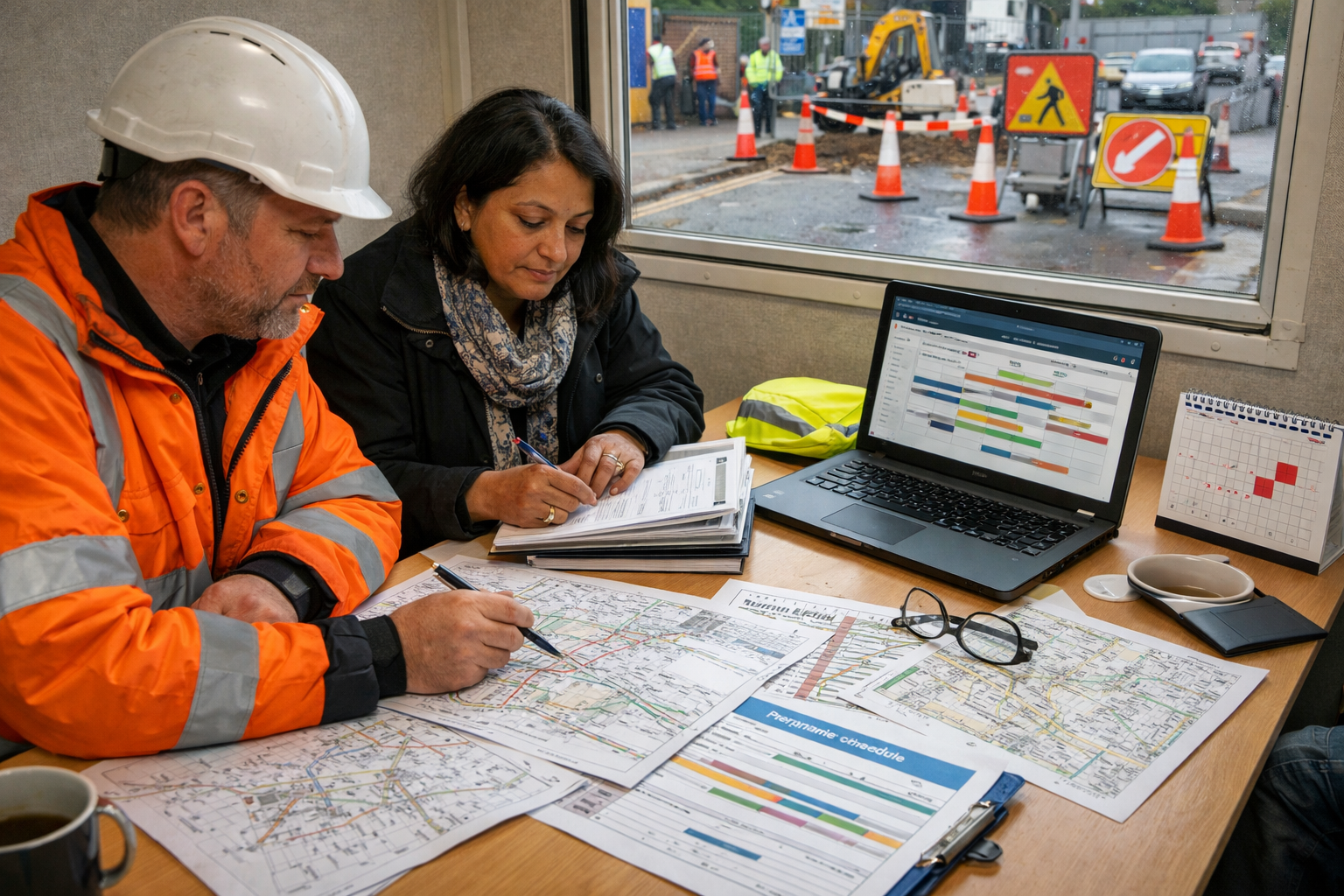
What is NRSWA and who does it apply to?
NRSWA is the legal framework that governs street and road works in the UK. It applies to utility undertakers, contractors working on their behalf, and in many cases non-utility organisations carrying out work in the highway under licence.[6][8]
In plain terms, NRSWA tells you:
- who can work in the street
- what notices or permits are needed
- how works must be signed, guarded and managed
- how excavations must be reinstated
- how authorities coordinate works to reduce disruption
For a deeper overview, see our Essential Guide to NRSWA Street Works and Compliance.
Who it’s for, and who it isn’t
Choose this framework as your starting point if you are:
- a contractor delivering utility or highway works
- a trainee working towards street works qualifications
- a site manager planning labour, plant, and sequencing
- a developer team dealing with highway openings or associated infrastructure works
It is not a substitute for your permit conditions, local authority scheme rules, or project-specific legal agreements.
“The jobs that go wrong usually don’t fail because the digging is difficult. They fail because planning, permits and sequencing were treated as an afterthought.”
Tony Flook, Managing Director, Highways Plus
Common mistake: assuming NRSWA only matters to utilities. It doesn’t. Non-utilities often need a Section 50 licence to open the highway, and the compliance burden can be stricter in practice.[1]
Do I need a permit, a notice, or a Section 50 licence?
Yes, in most cases you need formal permission to work in the highway. The exact route depends on who you are, what type of work you are doing, and whether the work is planned or immediate.[1][6]
The simple rule
- Statutory undertakers usually work under permit or noticing arrangements, depending on the authority’s scheme.[1][7]
- Immediate works can start quickly, but notice and permit requirements still apply within strict timescales.[1]
- Non-utility organisations usually need a Section 50 licence to place apparatus or excavate in the street.[1]
Permit vs licence at a glance
| Situation | Typical route | What to watch |
|---|---|---|
| Utility planned works | Permit application via authority scheme | Timing, conditions, traffic sensitivity |
| Utility immediate works | Immediate notice and retrospective permit steps | Short deadlines, evidence, accurate category |
| Developer or private contractor opening highway | Section 50 licence | Inspections, bonds, extra conditions |
| Highway authority works | Coordination under local process | Network impact and collaboration |
The Department for Transport’s updated coordination code puts more weight on early planning, collaboration, and disruption minimisation, with forward programmes expected to be shared over multi-year periods where relevant.[2][7]
If your project sits alongside wider highway works, our pages on Section 278 agreement works and project enabling works and site preparation give useful context.
Quick example
A developer needs to install private service connections across a public footway. The crew is ready, but no Section 50 licence is in place. The result? No lawful excavation, lost gang time, and possible rebooking of traffic management.
That delay is expensive, and completely avoidable.
What qualifications do I need for street works under NRSWA?
Street works must be carried out by properly qualified people. In practice, that means SWQR-registered operatives and supervisors for the relevant units, with at least one qualified operative on site and qualified supervision in place.[1][9]
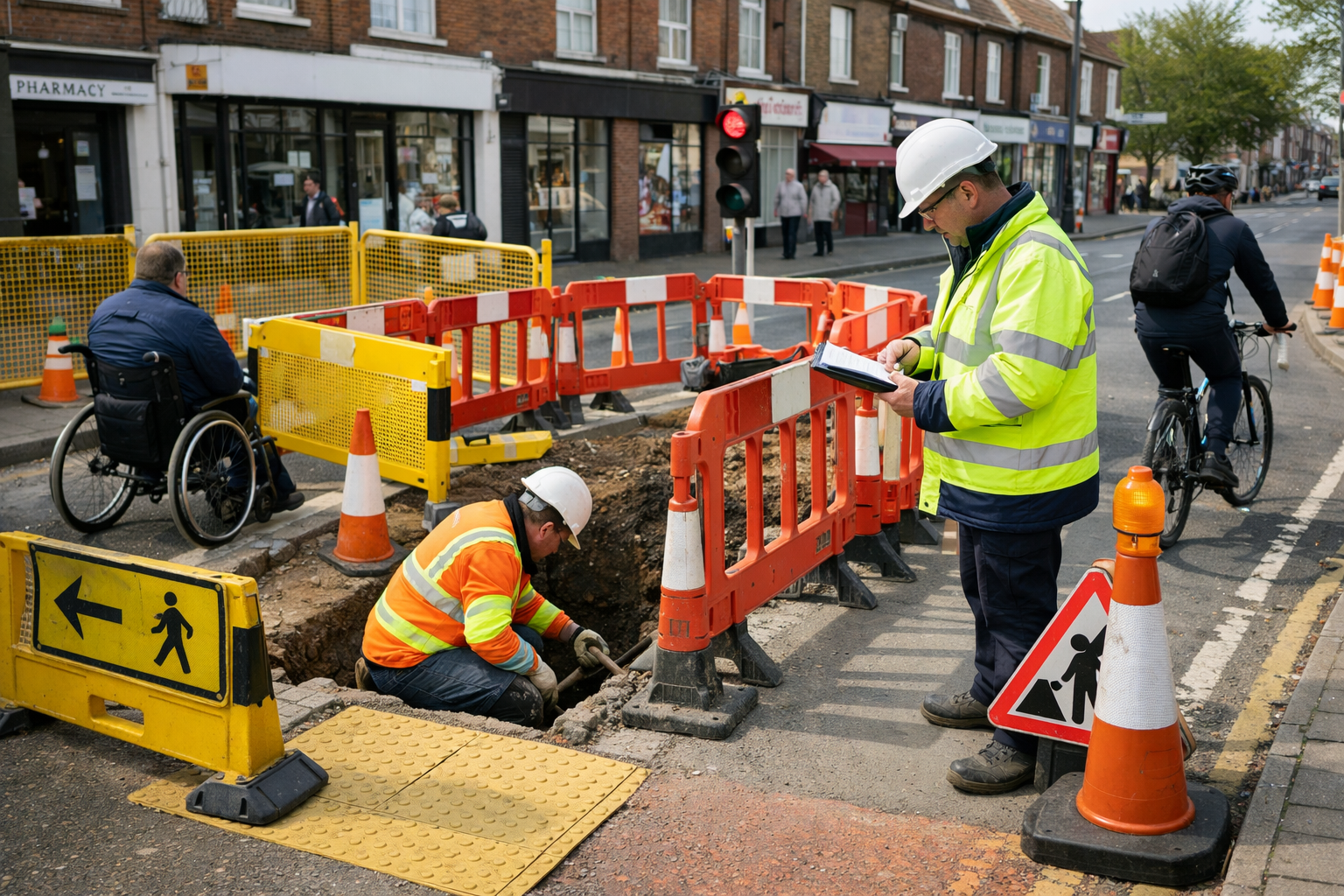
The practical site answer
For most excavation, reinstatement, signing, lighting and guarding tasks, you need:
- a qualified operative physically on site
- a qualified supervisor responsible for oversight
- qualifications matched to the type of work being done
Highways Plus highlights three core compliance pillars: permits through Street Manager, SWQR-qualified teams, and compliant Chapter 8 traffic management.[1] If one of those pillars is missing, risk rises fast.
Choose the right route
Choose operative units if you will be carrying out the works.
Choose supervisor units if you are overseeing and managing the works.
Choose refresher or reassessment planning early if your registration is close to expiry. Too many teams leave this until the week before a job starts.
Common mistake
Sending a generally experienced gang without checking the actual units held. Experience helps, but expired or incorrect qualifications won’t satisfy an inspection.
“A compliant gang list is not a box-tick. It’s one of the first things that protects programme certainty on live jobs.”
Ben Sperring, Surfacing and Civils Manager, Highways Plus
What changed in 2026 that contractors need to know?
Two changes matter straight away in 2026: the new coordination code and tougher consequences for poor programming and non-compliance. The 6th edition of the Code of Practice for the Co-ordination of Street and Road Works was issued in December 2025 and took effect as statutory guidance on 5 January 2026.[2][7]
What the 2026 coordination update means
The new code strengthens the focus on:
- permit scheme consistency
- early forward planning
- collaboration between promoters
- reducing disruption for road users, including vulnerable users
- considering network impact before approval[2][7]
HAUC also emphasised authority duties under Section 59 and undertaker cooperation under Section 60 in response to the updated code.[2]
Overrun charges now catch more days
From January 2026, Section 74A overrun charges apply to all days, including weekends and bank holidays, closing a loophole that previously softened the effect of non-working days.[2]
That means your programme logic needs to be more realistic.
Not more optimistic.
Also, industry analysis noted that some fixed penalty notices doubled in certain areas following 2025 amendments, with broader application taking effect in 2026.[3]
Actionable takeaway
Before you submit a permit:
- Check whether the street is traffic-sensitive or restricted.
- Build a programme with real curing times, reinstatement steps, and inspection risk.
- Confirm who owns each notice and update responsibility.
- Review clashes with utility and authority works in Street Manager.[1][7]
For ongoing support, our NRSWA compliance, consultancy and management service is designed for exactly this kind of programme risk.
What are the most common reasons jobs fail compliance checks?
Most NRSWA failures come from basic gaps, not obscure legal arguments. Late permits, poor guarding, missing qualifications, weak reinstatement, and bad updates are the repeat offenders.[1][3][4]
🔍 The usual problem areas
- permit conditions not followed on site
- wrong works category or duration
- notices not updated when the programme changes
- no qualified operative present
- barriers, signs or pedestrian routes not set correctly
- reinstatement not to spec
- site left inactive longer than planned
A site reality worth remembering
One of the easiest ways to lose time is to assume the authority will accept a variation because “the gang is nearly done”. They might not. And if the occupation remains live without proper updates, costs start to stack up.
Mini checklist before breaking ground
- Permit approved and conditions read?
- Gang qualifications checked?
- Traffic management drawings match live site?
- Materials and reinstatement spec confirmed?
- Out-of-hours contact and escalation clear?
- Start, stop and variation responsibilities assigned?
If your works involve surfacing tie-ins, drainage interfaces, or final reinstatement quality, these guides may help:
- road construction, repair and resurfacing
- highway drainage solutions and SuDS installation
- Chapter 8 traffic management services
How does Street Manager fit into this NRSWA FAQ?
Street Manager is the operational backbone for notices, permits, coordination and updates in many street works processes. If your information in Street Manager is late, incomplete, or inaccurate, your compliance risk goes up quickly.[1][7]
🗂 What you should be using it for
- permit applications
- notice submissions
- start and stop updates
- duration changes
- coordination visibility
- clash checking with other works
The updated coordination code places stronger emphasis on forward planning and shared programmes, including longer-term visibility where major works are involved.[2]
Choose this approach if you want fewer refusals
Use pre-application coordination if:
- the site is on a busy route
- multiple utilities are involved
- pedestrian management is tight
- the job may affect schools, bus routes, or peak-hour traffic
Depotnet’s analysis points to pre-application coordination as a practical way to reduce refusals and avoid enforcement issues under the tighter 2026 environment.[3]
Insider tip: Quarterly programme reviews often uncover chances for joint trenching or better sequencing. It takes effort, but it can reduce repeat occupation and wasted mobilisation.[2]
What happens if street works overrun or the reinstatement fails?
Overruns and failed reinstatement can trigger charges, inspections, remedial works, and repeat disruption. In 2026, the cost of poor programme control is harder to hide because overrun charging now applies across weekends and bank holidays too.[2]

What overrun usually means in practice
- extra occupation charges
- authority scrutiny
- more complaints from residents and businesses
- gang and traffic management rebooking
- possible knock-on delays to following trades
Reinstatement failure is not just a defect issue
Bad reinstatement can lead to:
- remedial excavation
- repeat inspections
- reputational damage with authorities and clients
- longer final account disputes
“The cheapest patch is often the one that costs the most six months later. Whole-life thinking matters, especially when adoption or guarantee exposure is involved.”
Mike Clancy, Non-Executive Director, Highways Plus
Quick decision rule
Choose a longer but realistic permit duration if the site has uncertain ground conditions, shared utility corridors, or weather-sensitive reinstatement.
Choose a tighter duration only when labour, plant, materials, traffic management and reinstatement are all locked in.
For developers worried about latent defects or adoption consequences, our backlog defect resolution and adoption management guide is worth a read.
Can different utilities share trenches or coordinate works together?
Yes, collaborative trenching and coordinated occupation can work well, but only if responsibilities are clear. The current code encourages collaboration because it can reduce disruption, repeat traffic management, and emissions from sequential works.[2]
🤝 When collaboration makes sense
- multiple utility works are planned in the same corridor
- a busy route cannot tolerate repeated closures
- the authority is pushing hard on occupation time
- resurfacing or final reinstatement can be combined efficiently
The catch
Collaboration creates questions about:
- who is the primary promoter
- who carries reinstatement responsibility
- how guarantees are split
- who controls programme changes
The code recommends clear primary and secondary promoter arrangements to reduce liability disputes.[2]
A practical example
We often see this on constrained urban sites: drainage, ducting, and footway reinstatement all competing for the same short possession window. If those packages are planned in isolation, someone loses time. If they are sequenced together early, everyone has a better chance of finishing without re-entering the highway.
This is especially relevant if your scheme also involves ducting and cabling installation or wider civil engineering services from design to adoption.
What is the best way to stay compliant and avoid penalties?
The best way to stay compliant is to control the basics before the gang arrives. Good NRSWA performance comes from planning, qualified people, accurate permit data, and disciplined site management, not from trying to fix issues after an inspection.

✅ A simple compliance checklist
Confirm the legal route
Permit, immediate works process, or Section 50 licence.[1]Check qualifications
Make sure operative and supervisor coverage is correct.[1][9]Review authority conditions
Especially timing, traffic sensitivity, and restricted streets.[2][7]Set traffic management properly
Signing, lighting, guarding, and safe pedestrian routes matter.[1][4]Own the updates
Assign one person to starts, stops, variations, and close-outs.Plan reinstatement early
Correct materials, compaction, surfacing interface, and inspection readiness.Coordinate before conflict happens
Speak to the authority and nearby promoters early, not after refusal.[2][3]
A finance angle people miss
Kerry Hopper, Finance Director at Highways Plus, often points out that avoidable compliance failures rarely show up as one neat line item. They leak into wasted labour, duplicated traffic management, delayed valuation, and margin erosion.
That is why planning accuracy matters commercially, not just legally.
Related reading
You may also find these useful:
- Highway compliance and regulations advice
- Highways news, advice, guides and blog insights
- Contact Highways Plus if you need project-specific support
FAQ
What is the pass mark for the NRSWA operative test?
The pass mark depends on the awarding body and test format, so always check the current course provider guidance. In practice, you should prepare for both knowledge and safe on-site application, not just multiple-choice recall.[4][9]
Can you do street works without NRSWA training?
Not lawfully in roles that require qualified operatives or supervisors. A general construction card is not a substitute for the correct street works qualification units.[1][9]
How long does a Section 50 licence take to get?
Timescales vary by authority, the road category, and the quality of your application. If traffic management, drawings, or supporting information are weak, approval usually takes longer.[1]
What counts as immediate works under NRSWA?
Immediate works are usually emergency or urgent works where delaying start would be unsafe or impractical. You can start quickly, but the notice and permit process still has strict requirements and short deadlines.[1][6]
Do NRSWA rules apply to footways as well as roads?
Yes. Street works controls can apply to footways, verges, and carriageways depending on the location and nature of the works.[6][8]
What is the most common NRSWA mistake by contractors?
The most common mistake is poor coordination between the permit application and the live site. If the approved conditions, timing, or traffic management do not match what is actually happening, enforcement risk rises quickly.[1][3]
Conclusion
A good nrswa faq should leave you with fewer grey areas, not more. The main point is simple: if you’re planning street works in 2026, you need to get four things right from the start – permission, people, programme, and protection.
Do that well, and most of the common headaches become manageable.
Leave it late, and even a small excavation can turn into a chain of delays, charges, and rework.
If you’re dealing with permits, utility interfaces, surfacing, or adoption risk and want straight commercial advice, Highways Plus can help you sense-check the route before the job goes live. Start with our NRSWA street works guide or get in touch with the team.
References
[1] Nrswa Street Works – https://www.highwaysplus.co.uk/nrswa-street-works/
[2] Blog – https://nrswastreetworks.com/blog
[3] Blog New Roads And Street Works Act 1991 Nrswa – https://www.depotnet.co.uk/blog-new-roads-and-street-works-act-1991-nrswa/
[4] Street Works Questions And Answers – https://constructiontest.co.uk/street-works-questions-and-answers/
[6] New Roads And Street Works Act – https://content.tfl.gov.uk/new-roads-and-street-works-act.pdf
[7] Street Works Co Ordination – https://www.gov.uk/government/publications/street-works-co-ordination
[8] legislation.gov.uk – https://www.legislation.gov.uk/ukpga/1991/22
[9] Faqs – https://nrswa-courses.co.uk/faqs/
Meta title
NRSWA FAQ: common street works questions answered
Meta description
NRSWA FAQ for contractors, trainees and site managers. Get clear answers on permits, qualifications, Street Manager, overruns and compliance in 2026.
nrswa faq, NRSWA, street works, Street Manager, Section 50 licence, permit schemes, SWQR, Chapter 8 traffic management, highway compliance, reinstatement, utility works, site management