Skip to content
Picture this: It’s 2026, and your multi-million-pound commercial development is ready to break ground. Planning permission? Secured. Finance? In place. Section 278 agreement drafted and almost signed. Then the utility search results land on your desk, and your heart sinks. A 132kV National Grid cable runs directly through your proposed junction improvement. The water main serving 3,000 homes crosses your new access road. And there’s a high-pressure gas main exactly where your pedestrian refuge needs to go.
Welcome to the world of section 278 utility diversions, where a £200,000 highway improvement can suddenly balloon to £600,000, and your 16-week construction programme stretches to 40 weeks. It’s the hidden iceberg that sinks development programmes, yet it’s entirely manageable with the right approach, early engagement, and expert coordination.
Key takeaways
- Utility diversions typically add 6-12 months to Section 278 programmes and can represent 30-50% of total project costs, making early identification and engagement critical to programme certainty
- Developers hold single point of accountability for coordinating National Grid, water companies, gas networks, and telecoms providers, requiring proactive multi-stakeholder management
- Early utility strategy integrated with CDM planning dramatically reduces risk of technical approval delays, cost overruns, and complications with highway adoption
- Protection works often provide better value than full diversions when feasible, but require detailed cost-benefit analysis and agreement with statutory undertakers
- Fixed-fee certainty and de-risked delivery depend on comprehensive utility investigations completed before committing to construction programmes or Section 278 agreement terms
Understanding section 278 utility diversions in 2026

Section 278 agreements under the Highways Act 1980 allow developers to fund alterations and improvements to existing public highways. Sounds straightforward enough. But here’s the reality: every square metre of British highway typically contains between three and seven separate utility services, each owned by different statutory undertakers, each with their own processes, timescales, and cost structures.
When your development requires highway works that conflict with existing utilities, someone has to move them. That someone is almost always you, the developer. And the cost? That’s yours too.
The hidden complexity
Utility diversions aren’t just about digging up pipes and putting them somewhere else. They involve:
- Detailed design by each utility company’s approved contractors
- Statutory consultation with multiple stakeholders
- Traffic management coordination to maintain live services during works
- Sequential dependencies where one utility must move before another can access their apparatus
- Testing and commissioning of new infrastructure before the old can be decommissioned
“I’ve seen developers budget £50,000 for what they thought was a simple water main diversion, only to discover the reality was closer to £180,000 once National Grid involvement, sequential working, and extended traffic management were properly scoped. Early engagement isn’t optional; it’s the difference between a viable scheme and a financial disaster.”
Tony Flook, Managing Director, Highways Plus
The financial impact is substantial. Medium-scale Section 278 schemes typically demand £50,000-£500,000 in total costs, with utility diversions often constituting 30-50% of this expenditure [5]. Design fees alone typically represent 5-10% of total construction cost and must account for utility search, diversion design, and coordination [5].
Why section 278 utility diversions derail development programmes
Let’s talk about what actually happens on the ground. You’ve got your Section 278 agreement signed, your contractor mobilised, and your sales team has promised completion dates to buyers. Then reality hits.
The six-month lead time problem
Utility diversion lead times frequently exceed six months from initial enquiry to completed works [2]. Here’s why:
Month 1-2: Utility searches and detailed surveys
Month 3-4: Diversion design by statutory undertaker
Month 4-5: Cost quotation and approval
Month 5-6: Statutory undertaker procurement and programming
Month 6+: Actual construction works
And that’s assuming everything runs smoothly. Which it rarely does.
The sequential working trap
Here’s a real scenario we encountered in Bristol in 2025. A developer needed to widen a junction to serve a 120-unit residential scheme. The utility survey revealed:
- Telecoms ducts at 450mm depth
- Water main at 900mm depth
- Gas main at 1,100mm depth
- Electricity cables at 1,200mm depth
Sounds manageable? Not quite. The telecoms provider needed 8 weeks. But they couldn’t start until the electricity cables were protected. The electricity works needed 6 weeks but couldn’t commence until the gas main was diverted. The gas works required 12 weeks. And the water company insisted their main had to move first because it served a hospital.
Total programme impact? 34 weeks instead of the 12 weeks originally planned. Cost increase? 180%.
Live traffic management complications
Working adjacent to live traffic during utility diversions creates heightened safety risk, requiring strict temporary traffic management protocols [1]. This isn’t just about putting out some cones.
You need:
- Chapter 8 compliant traffic management with properly trained operatives
- Two-way traffic signals to maintain flow while protecting work zones
- Permit coordination through the local authority’s street works team
- Emergency access provisions for utility failures
- Public liaison because residents get understandably frustrated
Each utility company often insists on separate traffic management phases. That means setting up, working, removing, then repeating the entire process for the next statutory undertaker. It’s inefficient, expensive, and frustrating for everyone involved.
“The technical challenge of utility diversions isn’t usually the problem. It’s the coordination. You’re trying to align five different organisations, each with their own priorities, timescales, and approval processes, while keeping traffic moving and residents happy. That’s where experience really counts.”
Ben Sperring, Surfacing and Civils Manager, Highways Plus
Early engagement: The only strategy that works
If there’s one lesson from three decades of highway adoption and Section 278 delivery, it’s this: early engagement with utility companies isn’t best practice, it’s the only practice that works.
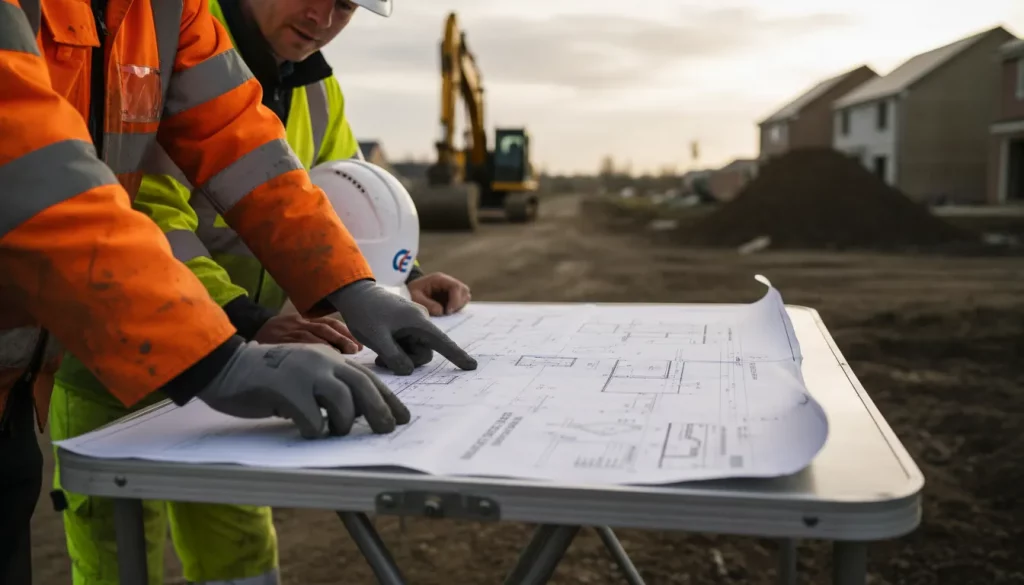
The utility search hierarchy
Start with comprehensive desktop searches:
Level 1: Free utility mapping from local authority records
Level 2: Paid searches from each statutory undertaker (£200-400 per utility)
Level 3: Ground-penetrating radar and electromagnetic surveys (£2,000-8,000)
Level 4: Trial holes to confirm exact locations and depths (£500-1,500 per hole)
Most developers stop at Level 2. That’s a mistake. Utility records are notoriously inaccurate, with location errors of 2-3 metres common on apparatus installed before 2000. On constrained urban sites, that margin of error is the difference between a viable design and an impossible one.
Pre-application engagement protocol
Before you submit your Section 278 design for technical approval, you need:
✅ Confirmed utility locations from physical surveys, not just records
✅ Initial diversion feasibility discussions with each statutory undertaker
✅ Outline cost estimates for each diversion (expect ±30% accuracy)
✅ Indicative programmes including their internal approval processes
✅ Alternative design options that might avoid diversions entirely
This pre-application work typically takes 8-12 weeks and costs £15,000-40,000 depending on site complexity [5]. But it’s the best money you’ll spend. It converts unknowns into knowns, and unknowns are what destroy development budgets.
The CDM Regulations angle
Don’t overlook the Construction (Design and Management) Regulations 2015. As the client, you have specific duties around identifying and managing foreseeable risks. Utility strikes are one of the most common causes of serious construction incidents.
Your CDM planning must address:
- Utility location verification before any excavation
- Safe systems of work near live services
- Emergency procedures for utility strikes
- Competence requirements for operatives working near utilities
- Information handover for the maintenance phase
Integrating utility strategy with CDM planning from the outset reduces Section 278 risks including delays to technical approval and eventual highway adoption [3].
Coordinating National Grid, water, and gas: A practical framework
Let’s get specific about the three major utility categories that cause the most complexity in Section 278 schemes.
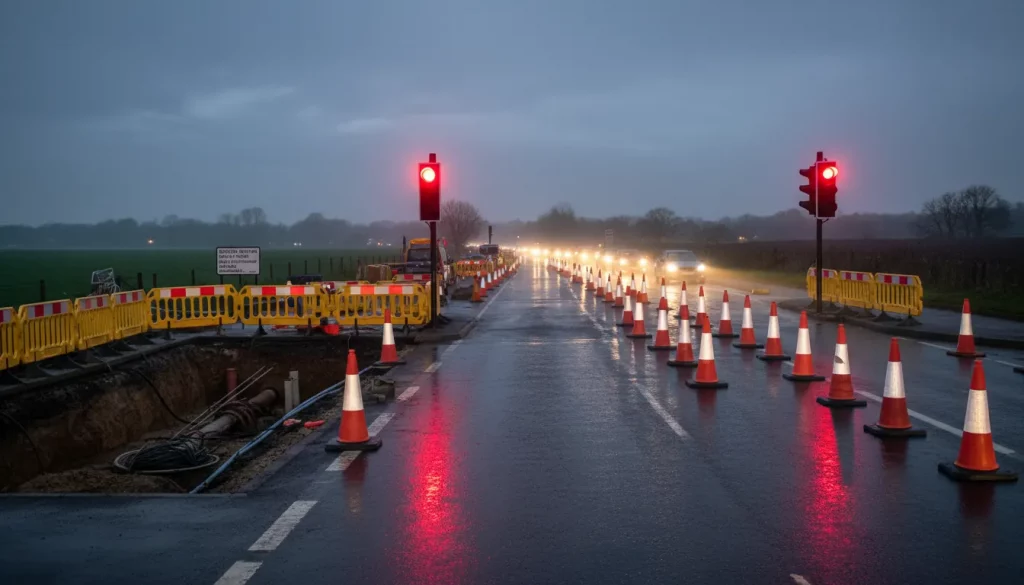
National Grid: High-voltage electricity diversions
National Grid diversions are typically the most expensive and time-consuming. A 132kV cable diversion can cost £500,000-£2 million and take 18-24 months from initial enquiry to energisation.
Key considerations:
- Wayleaves and easements for new cable routes may require third-party land
- Outage planning must align with network demand (winter diversions often impossible)
- Protection zones extend 3-10 metres either side of cables
- Adoption implications for ongoing maintenance access
National Grid operates a formal diversions process with defined stages. You’ll need to progress through feasibility, design, quotation, and construction phases, each with its own approval gates and timescales.
Pro tip: Explore whether cable protection rather than diversion is viable. Installing concrete protection slabs over existing cables costs perhaps 15% of a full diversion and can be completed in weeks rather than months.
Water company diversions
Water main diversions are more common and generally faster than electricity, but they come with their own challenges.
Typical costs for water diversions:
| Main diameter | Approximate cost | Typical programme |
|---|---|---|
| 90mm (domestic) | £8,000-15,000 | 8-12 weeks |
| 180mm (trunk) | £25,000-60,000 | 12-16 weeks |
| 300mm+ (strategic) | £80,000-200,000+ | 20-30 weeks |
Critical factors:
- Continuous supply must be maintained during works
- Pressure testing adds 2-3 weeks after installation
- Chlorination and flushing required before connection
- Section 104 adoption may be needed for new mains serving your development
Water companies are generally more responsive than electricity providers, but they’re highly risk-averse around supply interruption. Expect detailed scrutiny of your temporary supply proposals.
Gas network coordination
Gas diversions sit somewhere between electricity and water in terms of complexity and cost. High-pressure mains (over 2 bar) require specialist contractors and extensive safety protocols.
Programme killers to watch for:
- Purging and re-commissioning can take 3-5 days per connection
- Pressure governor relocations often overlooked in initial scoping
- Cathodic protection systems need specialist design
- Emergency access requirements may constrain your highway design
Gas networks are increasingly proactive about diversions, but their programmes are heavily dependent on contractor availability. In 2026, with major infrastructure projects competing for resources, lead times have extended significantly.
The protection versus diversion decision
Here’s a question that can save you hundreds of thousands: does the utility actually need to move, or can it be protected in situ?
When protection works
Protection is typically viable when:
✅ Your new construction depth is above the existing utility
✅ The utility can tolerate modest load increases from new pavement
✅ Future maintenance access remains feasible
✅ The statutory undertaker agrees protection is acceptable
Common protection methods include:
- Concrete protection slabs (typically 150mm thick reinforced concrete)
- Ductile iron sleeves for pipes
- Load distribution layers using cellular confinement systems
- Depth increases by lowering your construction profile
Cost-benefit analysis
Let’s look at a real comparison from a 2025 scheme in Leicestershire:
Option A – Full diversion:
- Divert 150mm gas main over 45 metres
- Statutory undertaker quote: £78,000
- Programme: 16 weeks
- Traffic management: £22,000
- Total cost: £100,000
Option B – Protection:
- Install reinforced concrete protection over existing main
- Materials and installation: £8,500
- Programme: 2 weeks
- Traffic management: £4,000
- Statutory undertaker supervision fee: £2,500
- Total cost: £15,000
The saving? £85,000 and 14 weeks. But here’s the catch: the statutory undertaker has to agree. And some won’t, particularly for strategic assets or where future access might be compromised.
Negotiating with statutory undertakers
Getting statutory undertakers to accept protection rather than diversion requires:
📋 Detailed structural calculations showing load paths and safety factors
📋 Maintenance access proposals demonstrating future serviceability
📋 Risk assessments addressing construction and operational phases
📋 Professional indemnity backing from your designer
📋 Persistent, professional negotiation – don’t accept the first “no”
Regulatory framework: What you must comply with
Section 278 utility diversions sit at the intersection of multiple regulatory regimes. Understanding your obligations prevents costly mistakes and approval delays.
The Highways Act 1980
Section 278 itself provides the legal mechanism for developers to fund highway alterations. But Section 278 agreements don’t override utility rights. Statutory undertakers have legal protection for their apparatus under various Acts, and they can’t be forced to move unless specific statutory powers are invoked [1].
This means negotiation, not compulsion, is your tool.
New Roads and Street Works Act 1991 (NRSWA)
NRSWA governs how utility companies and developers can work in the highway. Key provisions include:
- Noticing requirements for street works (minimum 10 days for minor works, more for major)
- Permit schemes in many local authorities (expect 2-4 week approval processes)
- Coordination of works to minimise disruption
- Reinstatement standards for excavations
- Inspection and defect regimes
Your Section 278 works must comply with NRSWA even though you’re working under a Section 278 agreement. The two regimes overlap, and both apply.
HAUC guidance
The Highway Authorities and Utilities Committee (HAUC) publishes national guidance on coordination and best practice. Their Diversionary Works Working Group specifically addresses the challenges we’re discussing here.
HAUC recommends:
- Early notification of proposed works to all affected utilities
- Joint working where multiple utilities need to move
- Coordination meetings throughout design and construction
- Performance monitoring of utility company responsiveness
While HAUC guidance isn’t legally binding, local highway authorities increasingly reference it in their Section 278 technical approval processes. Following HAUC recommendations demonstrates professional competence and reduces friction with approving authorities.
Local design guides
Most local highway authorities publish design guides that specify requirements for Section 278 schemes. The Leicestershire Highway Design Guide, for example, explicitly addresses utility treatment, bonds, and commuted sums.
Common local requirements include:
- Minimum separation distances between utilities and new structures
- Depth requirements for services under adoptable highway
- Duct and chamber specifications for future utility installations
- Commuted sum calculations for ongoing maintenance of utility apparatus
Suffolk County Council’s S278 construction guidance provides practical expectations for technical approval, traffic management, and on-site coordination – essential reading for anyone navigating the Section 278 process.
Financial management: Bonds, commuted sums, and cost responsibility
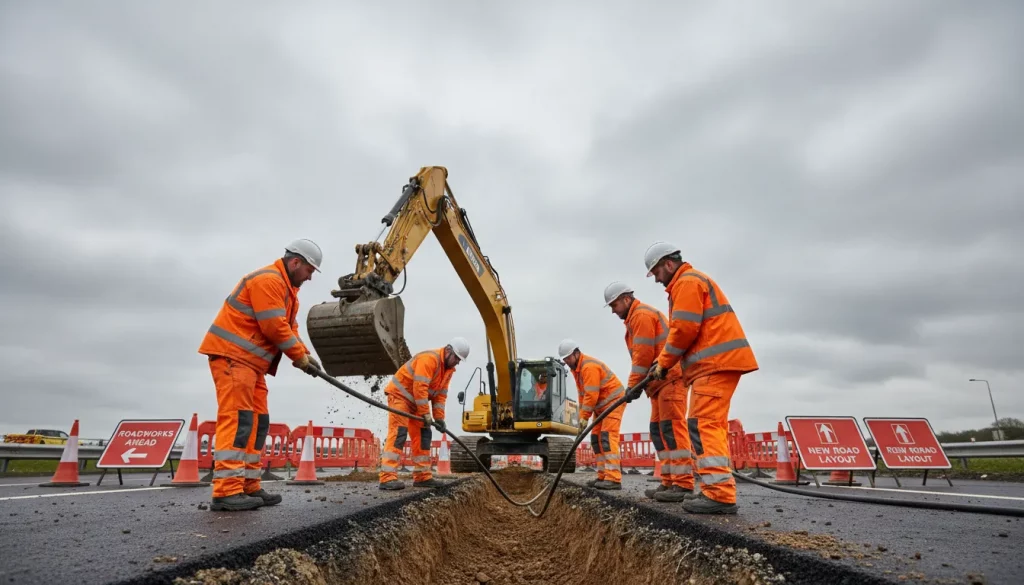
Let’s talk money. Specifically, who pays for what, and how you protect yourself from cost escalation.
Developer cost responsibilities
Under typical Section 278 agreements, developers are responsible for:
💷 All utility diversion costs including design, construction, and supervision
💷 Temporary traffic management during utility works
💷 Reinstatement of highway surfaces after utility excavations
💷 Coordination costs including project management and liaison
💷 Abortive costs if designs need to change due to utility conflicts
Statutory undertakers are not obliged to contribute to diversion costs, even if the diversion benefits their network. Some will negotiate cost-sharing for strategic improvements, but don’t bank on it.
Performance bonds
Performance bonds for Section 278 works typically range from 5-10% of contract value and provide financial security to cover utility diversion costs and remedial work [5]. The bond protects the local highway authority if you fail to complete works or if defects emerge during the maintenance period.
For schemes with significant utility content, expect:
- Higher bond percentages (8-10% rather than 5%)
- Extended bond periods (24-36 months rather than 12)
- Staged release tied to utility completion milestones
- Additional security for particularly complex or high-value diversions
The bond isn’t just a formality. If utility diversions overrun and you can’t fund completion, the highway authority will call the bond and complete works themselves. That’s expensive and damages your relationship with the authority for future schemes.
Commuted sums for utilities
Utility diversion commuted sums and maintenance responsibilities are calculated separately from standard highway maintenance. Some utilities require replacement provisions every 40 years over a 120-year road lifetime [5].
This creates significant long-term liabilities. A water main with a 40-year design life in a highway with a 120-year design period requires provision for two full replacements. If each replacement costs £60,000, that’s a £120,000 commuted sum on top of the initial installation cost.
Strategies to minimise commuted sums:
✓ Design utilities with extended design life (e.g., MDPE pipe rather than iron)
✓ Position apparatus outside the adoptable highway where possible
✓ Negotiate utility company retention of maintenance responsibility
✓ Use whole-life costing to justify higher initial investment
Understanding commuted sums and highway adoption requirements early in design prevents nasty surprises at technical approval stage.
Fixed-fee certainty
One of the biggest challenges with utility diversions is cost uncertainty. Statutory undertaker quotes are typically valid for only 90 days, and they’re often ±30% estimates rather than fixed prices.
This creates real problems for development appraisals and funding drawdowns. How do you commit to a land purchase or construction contract when a major cost element could vary by hundreds of thousands?
Approaches to managing uncertainty:
- Contingency provisions of 30-50% on utility budgets (painful but realistic)
- Fixed-price novation where your contractor takes on utility coordination risk
- Phased approvals that allow design refinement before committing to diversions
- Value engineering to eliminate or minimise diversions through design changes
At Highways Plus, our approach centres on fixed-fee certainty and de-risked delivery. We take single point of accountability for utility coordination, converting uncertain statutory undertaker estimates into fixed-price commitments backed by our professional indemnity and performance bonds.
Case study: Complex urban Section 278 with multiple utility conflicts
Let me share a scheme we delivered in 2025 that illustrates these principles in practice.
The challenge
A mixed-use development in a historic market town required significant highway improvements: a new signalised junction, widened carriageway, and upgraded pedestrian facilities. The site fronted a constrained urban road with:
- National Grid 11kV cables serving 2,000 properties
- Strategic water main (300mm diameter)
- High-pressure gas main (180mm, 4 bar)
- BT and Virgin Media telecoms infrastructure
- Street lighting and traffic signal cables
Total highway works budget: £340,000. Initial utility diversion estimates: £280,000-420,000 (yes, the range was that wide). Programme: 22 weeks for highway works, plus “TBC” for utilities.
The approach
We started with comprehensive surveys: GPR, electromagnetic detection, and 12 trial holes to confirm exact utility locations. Cost: £18,000. Value: immeasurable.
The surveys revealed the National Grid cables were 400mm shallower than records indicated. That single discovery changed everything. Instead of a £180,000 diversion, we could design the junction profile to clear the cables with 150mm protection slabs. Saving: £165,000.
The water main was exactly where records showed, but we identified an alternative route using the developer’s land rather than highway. This allowed the water company to install the new main on their standard terms rather than as a Section 278 diversion. Programme benefit: 8 weeks. Cost saving: £35,000.
The gas main couldn’t be avoided, but early engagement with the gas network operator identified a planned renewal programme in the area. We negotiated to bring forward their works and integrate them with our Section 278 programme. Their contribution: £40,000 towards the diversion cost.
The outcome
Final utility costs: £127,000 (62% below the initial mid-range estimate)
Programme: 26 weeks total (including all utility works)
Variations during construction: Zero
Technical approval: First submission
Highway adoption: Completed 12 months after practical completion
The keys to success?
✅ Comprehensive surveys before design commitment
✅ Early engagement with all statutory undertakers
✅ Design flexibility to work around constraints
✅ Professional coordination throughout delivery
✅ Single point of accountability for the client
“This project demonstrates what’s possible when utility coordination is treated as a core design consideration rather than an afterthought. The client saved over £250,000 compared to the worst-case scenario and achieved programme certainty that allowed them to pre-sell units with confidence.”
Tony Flook, Managing Director, Highways Plus
Practical lessons: What works and what doesn’t
After three decades of delivering Section 278 agreements and Section 38 adoptions, certain patterns become clear.
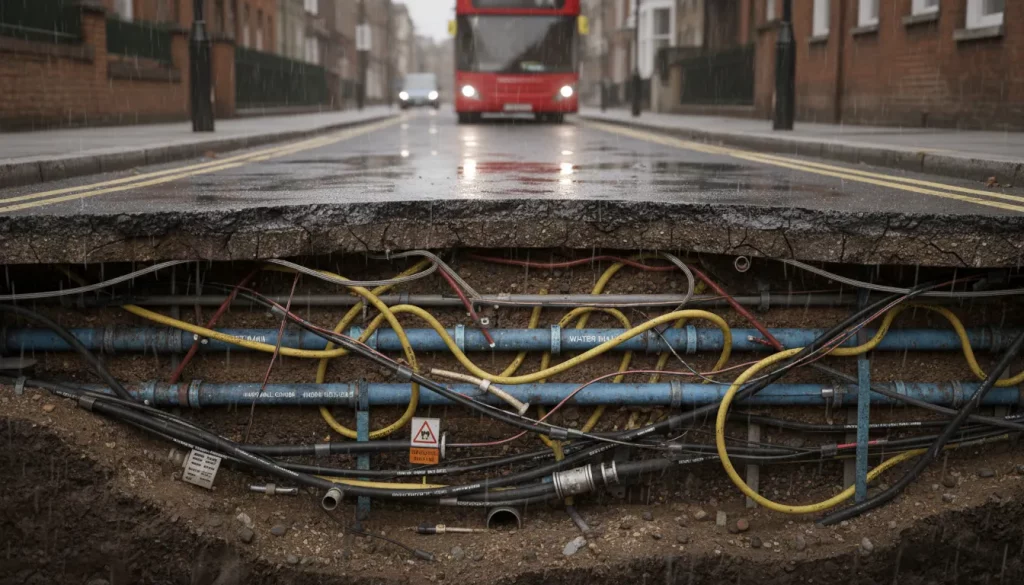
What works
1. Survey before you design
Don’t design based on utility records. They’re wrong more often than they’re right. Invest £15,000-25,000 in comprehensive surveys and save £100,000+ in abortive design and construction costs.
2. Engage utilities in parallel, not sequence
Waiting for one utility’s response before approaching the next adds months to your programme. Contact all statutory undertakers simultaneously and manage the responses in parallel.
3. Explore protection before committing to diversion
Every diversion you can avoid through protection or design modification saves 3-6 months and tens of thousands of pounds. Push back on statutory undertakers who default to diversion without properly considering alternatives.
4. Build contingency and use it strategically
A 40% contingency on utility costs isn’t excessive; it’s realistic. But don’t just accept cost overruns. Use the contingency as leverage to drive value engineering and challenge unnecessary works.
5. Integrate utility strategy with overall programme
Utility diversions aren’t a separate workstream that happens before your main works. They’re integral to your critical path and need to be programmed, resourced, and managed accordingly.
What doesn’t work
❌ Assuming utility records are accurate – They’re not. Ever.
❌ Leaving utility engagement until after planning permission – You need outline costs and programmes for your planning application viability assessment.
❌ Accepting the first statutory undertaker quote – These are often worst-case estimates. Challenge assumptions and explore alternatives.
❌ Trying to coordinate multiple utilities yourself – Unless you have dedicated, experienced resources, this becomes a full-time job that overwhelms development teams.
❌ Underestimating traffic management costs – Temporary signals, permit fees, and extended working hours add up fast. Budget £800-1,200 per week for typical urban traffic management.
Frequently asked questions
How do utility diversions impact the programme and cost of Section 278 highway works for developers in the UK?
Utility diversions typically add 6-12 months to Section 278 programmes and can represent 30-50% of total project costs [1][5]. Lead times from initial enquiry to completed works frequently exceed six months, with complex diversions involving National Grid or strategic water mains taking 18-24 months. Costs vary dramatically: a simple telecoms duct diversion might cost £8,000-12,000, while a high-voltage electricity diversion can exceed £500,000. The financial impact extends beyond direct diversion costs to include extended traffic management, programme delay costs, and increased professional fees for coordination and design modifications.
What are the respective responsibilities of the developer, local highway authority, and statutory undertakers during S278 works and utility diversions?
The developer holds single point of accountability for identifying, coordinating, and funding all utility diversions required for their Section 278 works [2][3]. This includes obtaining quotes, managing programmes, and ensuring completion before highway adoption. The local highway authority provides technical approval of designs, coordinates street works permits, and ensures compliance with adoption standards. Statutory undertakers are responsible for designing diversions to their standards, carrying out works safely, and maintaining diverted apparatus. However, undertakers have no obligation to prioritise developer schemes or contribute to costs unless the diversion benefits their network. The developer must therefore drive coordination and accept programme risk.
How should National Grid, water companies, and gas undertakers be coordinated to minimise disruption during highway construction and live traffic management?
Effective coordination requires simultaneous early engagement with all statutory undertakers, not sequential approaches that extend timescales [2]. Establish a multi-party coordination group with regular meetings throughout design and construction phases. Develop an integrated traffic management strategy that allows sequential utility works within a single traffic management setup where possible, rather than separate phases for each undertaker. Align street works permits and highway authority approvals to create continuous working windows. Consider appointing a specialist utilities coordinator with established relationships and technical credibility with statutory undertakers. Share design development proactively and involve utility companies in value engineering discussions. Where multiple diversions are unavoidable, programme the longest-lead items first and use parallel working where apparatus depths and locations allow.
What do UK regulations and guidance (Highways Act, NRSWA, HAUC, local design guides) require when diverting utilities in S278 schemes?
Section 278 of the Highways Act 1980 provides the legal framework for developer-funded highway alterations but doesn’t override statutory undertakers’ rights [1]. NRSWA governs the practical execution of works, requiring appropriate notices (typically 10 days minimum), permits in designated areas, and compliance with reinstatement standards. HAUC guidance, while not legally binding, sets best practice expectations for coordination, early notification, and joint working that local authorities increasingly reference in technical approvals. Local design guides specify technical requirements such as minimum separation distances (typically 500mm between services), depth requirements (usually 450mm minimum under adoptable highway), and commuted sum calculations. The Leicestershire Highway Design Guide and Suffolk’s S278 construction guidance provide detailed local authority expectations.
When are utility protection works preferable to full diversion, and how do cost responsibilities work between the promoter and statutory undertakers?
Protection is preferable when the utility can remain in situ with additional protective measures, typically saving 70-85% of diversion costs and reducing programmes from months to weeks. Protection works when new construction depth is above existing apparatus, the utility can tolerate modest load increases, and future maintenance access remains viable. The statutory undertaker must agree protection is acceptable for their asset. Cost responsibility remains with the developer for both protection and diversion options – undertakers rarely contribute unless the works benefit their network. However, protection costs are typically £10,000-20,000 compared to £60,000-150,000 for equivalent diversions. The developer funds design, materials, installation, and statutory undertaker supervision fees (usually £2,000-5,000) for protection works.
How can early utilities strategy and CDM planning reduce Section 278 risks such as delays to technical approval and highway adoption?
Early utility strategy converts unknowns into knowns, allowing accurate programming and budgeting before committing to land purchases or construction contracts [3]. Comprehensive surveys (GPR, trial holes) costing £15,000-25,000 identify conflicts that utility records miss, enabling design modifications that avoid diversions entirely. Early statutory undertaker engagement secures outline costs and programmes for planning viability assessments and Section 278 negotiations. CDM planning integration ensures utility risks are properly assessed, safe systems of work are designed rather than improvised, and information is properly handed over for the maintenance phase. This approach typically adds 8-12 weeks to pre-construction programmes but reduces construction phase delays by 3-6 months and eliminates variations that derail budgets and technical approvals.
What practical lessons and case study insights exist from complex S278 schemes involving major utility diversions on constrained urban roads?
Real-world experience demonstrates that comprehensive surveys before design commitment deliver 10:1 return on investment by identifying conflicts early when design changes are cheap [4]. Parallel engagement with all utilities rather than sequential approaches saves 2-4 months on typical programmes. Protection options should be explored for every utility before accepting diversion as inevitable – 30-40% of initial diversion proposals can be eliminated through design modification or protection. Statutory undertaker quotes are starting points for negotiation, not fixed requirements. Traffic management costs are consistently underestimated – budget £800-1,200 per week for urban schemes with live traffic. Single point of accountability through an experienced civil engineering partner provides better outcomes than developers attempting to coordinate multiple utilities themselves while managing their core development activities.
Conclusion: De-risking Section 278 utility diversions in 2026
Section 278 utility diversions don’t have to be the programme-wrecking, budget-destroying nightmare that many developers experience. With the right approach, they become manageable, predictable, and sometimes even avoidable.
The fundamentals are clear:
Survey comprehensively before you design. Utility records are guidance, not gospel.
Engage early with all statutory undertakers. Six months before you think you need to is about right.
Explore alternatives systematically. Protection, design modification, and phasing can eliminate 30-50% of initial diversion requirements.
Programme realistically. Add 6-12 months for utility works to your baseline construction programme, not 6-12 weeks.
Budget generously. A 40% contingency on utility costs isn’t pessimistic; it’s prudent.
Coordinate professionally. This is specialist work requiring established relationships, technical credibility, and persistent follow-up.
Your next steps
If you’re facing Section 278 utility diversions on your development, take action now:
- Commission comprehensive utility surveys before finalising your design
- Engage all statutory undertakers simultaneously with clear information requests
- Explore protection and design alternatives before accepting diversions as inevitable
- Integrate utility strategy with your CDM planning and risk management
- Consider specialist support to provide single point of accountability and fixed-fee certainty
At Highways Plus, we’ve delivered successful Section 278 schemes across the UK, coordinating complex utility diversions while maintaining programme certainty and cost control. Our approach combines deep technical expertise with established statutory undertaker relationships and a commitment to de-risked delivery.
Whether you need Section 278 agreement works, Section 38 road adoption, or Section 104 sewer adoption, we provide the consultative expertise and delivery capability to navigate utility challenges successfully.
Your project is our business. Let’s talk about how we can help you achieve programme certainty, capital release, and compliance-ready delivery on your next Section 278 scheme.
Ready to de-risk your Section 278 utility diversions? Contact our team for a no-obligation discussion about your specific challenges and how we can help.
References
[1] What Developers Need to Know About Section 278 Works – https://gce-ltd.co.uk/groundworks/key-facts-for-developers-on-section-278-works/
[2] What is the S278 process? – https://linkeng.co.uk/how-we-work/you-ask-we-answer/what-is-the-s278-process/
[3] S38 and S278 Agreements with Local Highways Authorities – https://www.civilistix.com/news/s38-and-s278-agreements-with-local-highways-authorities/
[4] S278 London Road, Lichfield – New Access – https://www.staffordshire.gov.uk/Highways/roadworks/lichfield/S278-London-Road-Lichfield-New-Access.aspx
[5] How much does a Section 278 agreement cost? – https://linkeng.co.uk/how-we-work/you-ask-we-answer/how-much-does-a-section-278-cost/
[6] What Are S278 Works and Why They Matter for UK Developments – https://www.killingley.co.uk/hard-landscaping/what-are-s278-works/
[7] Leicestershire Highway Design Guide – Section 278 and highway adoption requirements – https://www.leicestershirehighwaydesignguide.uk/approvals-road-adoptions-and-commuted-sums/section-278-agreements-and-highway-adoption
[8] Suffolk County Council S278 construction guidance – https://www.suffolk.gov.uk/asset-library/imported/guidance-for-s278-agreement-construction.pdf
[9] HAUC UK Diversionary Works Working Group – https://www.hauc-uk.org.uk/about/our-work/diversionary-works