Skip to content
Here’s something that’ll make you sit up: from 2026 onwards, getting your drainage design wrong isn’t just inconvenient. It’s a planning refusal waiting to happen.
The regulatory landscape for SuDS drainage adoption has fundamentally shifted. From 2026 onwards, SuDS drainage adoption will be mandatory for most new developments across England. Schedule 3 of the Flood and Water Management Act 2010 has finally activated, and with it comes a completely new approval pathway that’s catching developers off guard.
You’re no longer dealing with drainage as a secondary consideration that gets sorted post-planning. SuDS Approving Bodies (SABs) within local authorities now hold gatekeeping power over your construction timeline. No SAB approval? No construction commencement. It’s that simple.
Understanding SuDS drainage adoption is essential for any developer. The changes introduced mean that each project will need to adhere closely to these new standards from the outset to avoid delays caused by non-compliance.
The question isn’t whether you need compliant SuDS anymore. It’s how you design systems that councils will actually approve without delays, rejections, or costly redesigns.
Key takeaways for SuDS drainage adoption
- Mandatory pre-construction SAB approval is now required for most developments, creating a separate approval pathway distinct from traditional planning permission
- Rainwater reuse has become the top-priority runoff destination in DEFRA’s updated hierarchy, ahead of infiltration or sewer discharge
- Early design integration is critical – SuDS must be embedded from initial site layouts, requiring coordination between drainage specialists, landscape architects, and civil engineers
- Product certification requirements (CE/UKCA marks plus third-party validation) are essential for de-risking approval and demonstrating compliance
- Commuted sum assessments determine long-term financial obligations, making whole-life cost planning a front-end design consideration
Understanding the 2026 SuDS drainage adoption regulatory shift
Let’s cut through the noise. The regulatory changes happening right now represent the most significant shift in drainage design requirements since the original Flood and Water Management Act passed over a decade ago.
What’s actually changed?
Schedule 3 activation means SuDS are no longer optional recommendations. They’re mandatory requirements for the majority of new developments[1][2]. This isn’t a gradual phase-in. It’s immediate.
The implications of SuDS drainage adoption extend beyond immediate compliance, impacting long-term maintenance and operational costs associated with your development.
Local authorities have established dedicated SuDS Approving Bodies within their planning departments. These SABs operate as separate entities from traditional planning teams, creating an entirely new approval pathway you must navigate[1][2]. Think of them as specialist gatekeepers focused exclusively on drainage performance.
The critical shift: drainage plans now require explicit SAB approval before any construction work begins[2]. You can’t start groundworks while sorting drainage details. The approval must be in place first.
Why this matters for your development timeline
Under the updated National Planning Policy Framework (December 2025), planning permission may be refused for sites that don’t incorporate a structured SuDS approach within initial design proposals[3]. This elevates drainage from a technical detail to a planning-critical element.
Engaging with local authorities about SuDS drainage adoption early in the planning process can pave the way for a smoother approval path.
“We’re seeing developers who’ve worked the same way for 20 years suddenly facing refusals because they haven’t adapted to the new SuDS requirements. The councils aren’t being difficult – they’re following mandatory standards that didn’t exist in this form before.” – Tony Flook, Managing Director
The approval pathway now involves multiple stakeholders with distinct requirements:
- Water companies follow OFWAT’s Design and Construction Guidance (DCG)
- Lead Local Flood Authorities (LLFAs) evaluate designs against local flood risk management strategies
- Highways authorities require compliance with DMRB for strategic road networks[4]
Each has separate approval criteria. Each can delay your project.
The financial implications
SABs must evaluate long-term maintenance and repair costs before approving your SuDS assets. This determines the commuted sums you’ll pay when handing systems over to adopting bodies[4]. These aren’t token fees – they’re calculated based on 10+ year performance horizons and whole-life maintenance costs.
Getting this wrong at design stage doesn’t just mean redesign costs. It means negotiating higher commuted sums because your system requires more intensive maintenance than necessary.
What “compliance-ready” actually means in 2026
Your drainage design must now demonstrate:
- Management of at least the first 5mm of rainfall on-site for the majority of rain events[4]
- Strict numerical limits on post-development runoff discharge rates matching natural hydrological processes[2]
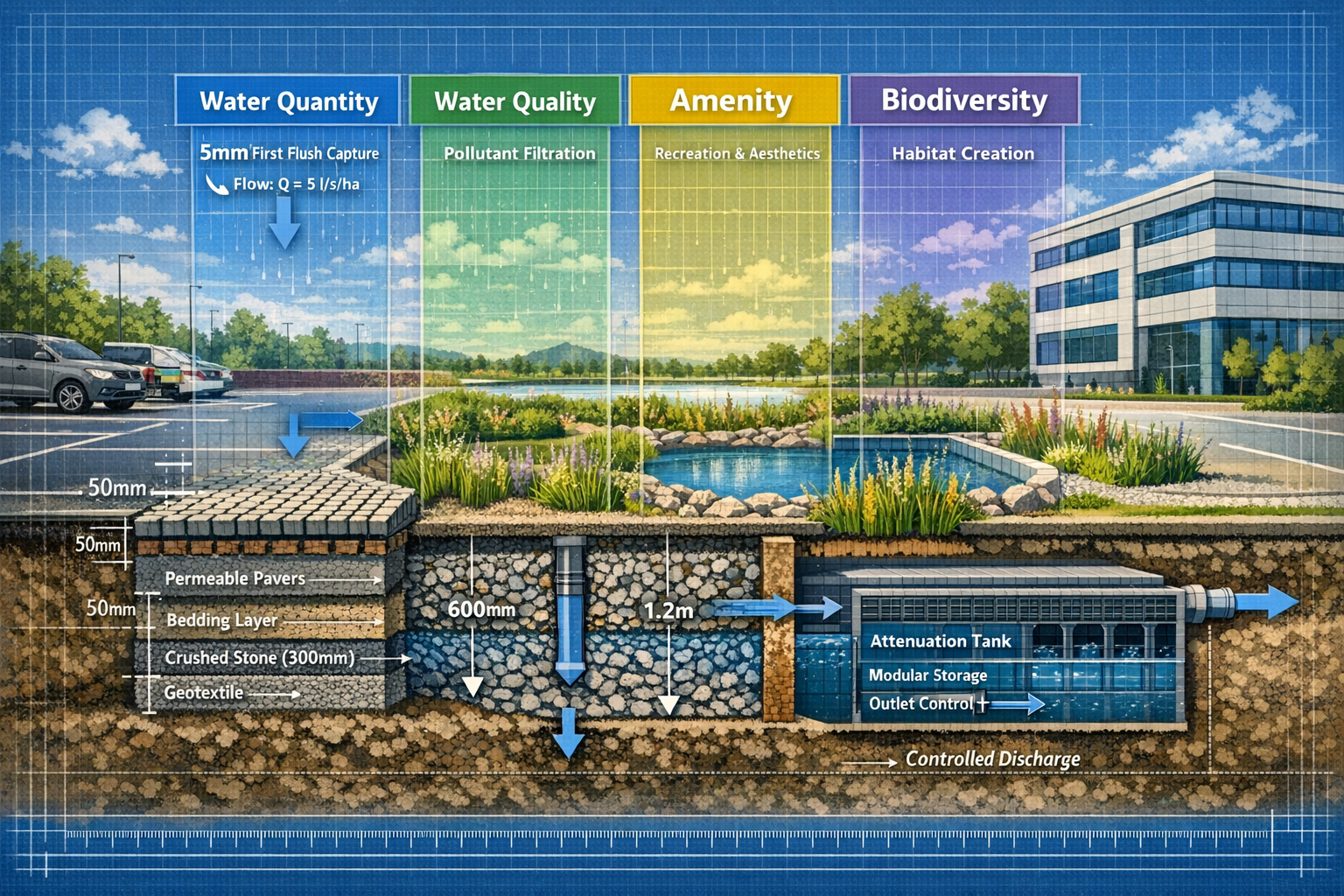
- Integration across four pillars: water quantity, water quality, amenity value, and biodiversity benefits[4]
- Product certifications (CE/UKCA marks minimum, with third-party validation from BBA, WRc, or BSI increasingly expected)[4]
This is where many developers stumble. They design functional drainage systems that manage water effectively, but fail to demonstrate compliance in the documentation format SABs require.
For developers working on Section 38 highway adoption or Section 104 sewer adoption projects, the SuDS requirements add another layer of complexity to already intricate approval processes. The drainage must satisfy SAB requirements while also meeting adoption standards for the relevant authority.
Designing for SuDS drainage adoption: The four pillars approach
Here’s where theory meets tarmac. The 2026 standards mandate that your SuDS design must deliver across four distinct pillars simultaneously. Not sequentially. Not as optional extras. All four, integrated from day one.
Pillar One: Water quantity management
This is the traditional drainage function, but with stricter requirements than before. Your system must control and slow water release to match natural hydrological processes[2].
The practical reality? You need to demonstrate that post-development runoff doesn’t exceed pre-development rates for multiple storm events:
- 1 in 1 year storm (everyday rainfall)
- 1 in 30 year storm (design standard)
- 1 in 100 year storm plus climate change allowance (extreme events)
Your attenuation calculations must account for climate change factors. For most of England, that means applying a 40% uplift to peak rainfall intensity. Some regions require higher allowances.
Pillar Two: Water quality protection
The updated SuDS hierarchy (December 2025) positions rainwater reuse and harvesting as the top-priority runoff destination[4]. This is a fundamental shift. Before considering infiltration, discharge to water bodies, or connection to sewers, you must evaluate rainwater harvesting potential.
The “first flush” requirement mandates managing at least the first 5mm of rainfall on-site[4]. This initial runoff carries the highest pollutant load – oils, sediments, chemicals from surfaces. Capturing it prevents contamination of receiving watercourses.
For commercial developments, this often means incorporating treatment trains:
- Source control – permeable paving, green roofs, filter strips
- Site control – swales, bioretention areas, filter drains
- Regional control – detention basins, constructed wetlands
Each stage removes different pollutants. Skip a stage, and you’re likely failing water quality requirements.
“The biggest mistake we see is developers treating water quality as an afterthought. They design for volume and flow rates, then try to retrofit pollution control. It doesn’t work. Water quality drives your component selection and layout from the start.” – Ben Sperring, Surfacing and Civils Manager
Pillar Three: Amenity value
This is where many technical designers struggle. SABs now explicitly assess whether your SuDS provide amenity benefits to the development and wider community[4].
What does this look like practically?
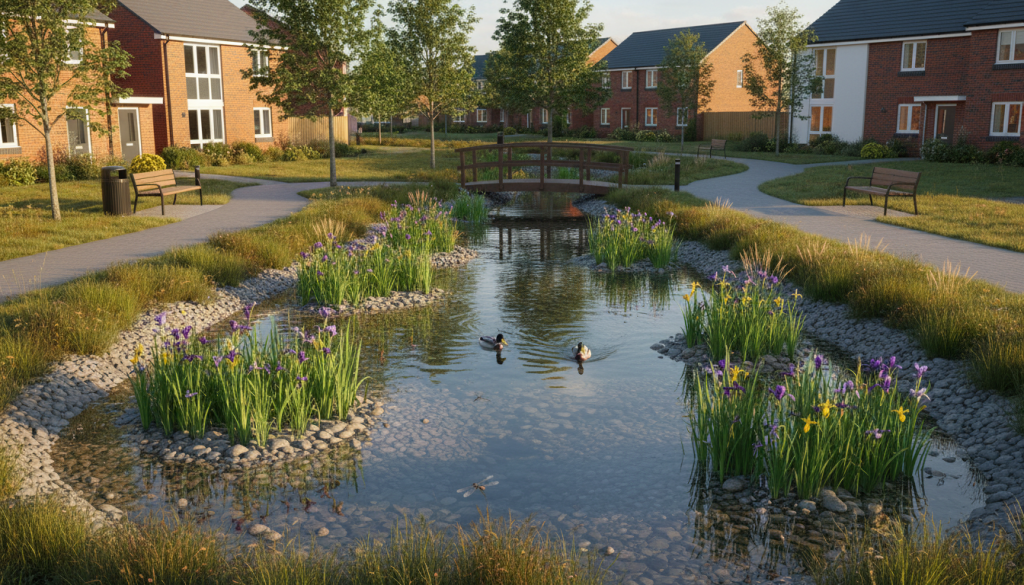
- Detention basins designed as attractive landscape features, not fenced-off eyesores
- Swales integrated into pedestrian routes with seating areas
- Rain gardens positioned where residents can see and appreciate them
- Clear, safe access for maintenance without compromising public use
The standards don’t specify exact amenity requirements, but they do require demonstration that you’ve considered and maximized amenity potential. Generic “we’ve planted some grass” approaches won’t satisfy SABs.
This requires genuine collaboration between drainage engineers and landscape architects from initial concept stages. Not a landscape plan drawn over completed drainage layouts.
Pillar Four: Biodiversity enhancement
Standard 6 of the updated National SuDS Standards explicitly mandates biodiversity integration[4]. Your drainage system must actively support local ecosystems.
Practical requirements include:
- Native plant species selection appropriate to local conditions
- Varied water depths to support different species
- Habitat creation features (log piles, stone refuges, shallow margins)
- Connection to existing green infrastructure corridors where possible
- Year-round interest and food sources for wildlife
This aligns with broader Biodiversity Net Gain (BNG) requirements, but SuDS-specific biodiversity goes beyond generic BNG calculations. SABs want to see evidence that your water management infrastructure actively enhances local ecology.
For developers already navigating sustainable road construction requirements, the biodiversity pillar offers opportunities to integrate drainage with wider sustainability goals. Rain gardens and bioswales can contribute to both drainage performance and BNG targets.
Integration is non-negotiable for SuDS Drainage Adoption
Here’s the challenge: these four pillars aren’t separate design objectives you can address independently. They’re interconnected requirements that must be balanced.
A detention basin designed purely for flood attenuation might satisfy Pillar One but fail Pillars Three and Four. A beautiful rain garden that provides excellent amenity might not provide sufficient treatment for Pillar Two.
The approval pathway requires demonstrating how your design delivers across all four pillars simultaneously. This is why early integration with specialist highway drainage solutions expertise is essential – you need professionals who understand the interconnections, not just individual components.
Navigating the SAB approval pathway for SuDS drainage adoption
Right. You’ve designed a system that addresses all four pillars. Now comes the approval gauntlet.
The SuDS drainage adoption process is distinct from traditional planning permission, necessitating a thorough understanding of new requirements.
Pre-application engagement: Your secret weapon
Most SABs offer pre-application advice services. Use them. Seriously.
These consultations allow you to present outline proposals before formal submission, identifying potential issues when changes are still straightforward and inexpensive. SABs can clarify their specific interpretation of national standards, highlight local constraints you might have missed, and indicate whether your approach aligns with their expectations.
The fee for pre-application advice (typically £500-£1,500 depending on development size) is trivial compared to the cost of redesigning after formal refusal.
What SABs actually scrutinise
Your submission needs to demonstrate compliance across multiple dimensions. SABs assess:
Technical performance: Do your calculations demonstrate adequate attenuation, appropriate discharge rates, sufficient treatment capacity? Are your assumptions reasonable and evidenced?
Product compliance: Do all components carry required certifications (CE/UKCA marks minimum)? Is there third-party validation from recognised bodies (BBA, WRc, BSI)?[4] Generic “equivalent to” claims for uncertified products are increasingly rejected.
Maintenance accessibility: Can the system be maintained without specialist equipment or unreasonable cost? Are access points clearly defined and appropriately located?
Adoption suitability: If you’re proposing adoption by a third party (water company, LLFA, highways authority), have you demonstrated the system meets their specific adoption standards?
Long-term resilience: How will the system perform after 10, 20, 30 years? What’s the replacement schedule for components with limited lifespans?
This last point drives commuted sum calculations. SABs model whole-life costs including:
- Routine maintenance (vegetation management, sediment removal, inspection)
- Periodic repairs (geotextile replacement, pipe repairs, structural maintenance)
- Component replacement (pumps, control structures, outfall headwalls)
- Emergency interventions (blockage clearance, erosion repair)
Higher predicted costs mean higher commuted sums.
The documentation SABs expect
Your submission package should include:
- Drainage strategy report explaining your approach, constraints considered, and how you’ve addressed the four pillars
- Detailed design drawings showing all components, dimensions, levels, materials, and construction details
- Hydraulic calculations demonstrating performance for required storm events
- Water quality assessment showing pollutant removal capacity
- Maintenance and management plan detailing all maintenance activities, frequencies, and responsibilities
- Product certifications for all proprietary components
- Adoption agreements (draft or confirmed) with intended adopting bodies
Missing or inadequate documentation is the most common cause of delays. SABs can’t approve what you haven’t demonstrated.
“We see developers submit beautiful concept drawings with minimal technical backup, then wonder why approval takes months. SABs need evidence, not artistic impressions. The developments that sail through approval have comprehensive technical documentation from day one.” – Tony Flook, Managing Director
Timeline expectations
SABs have statutory consultation periods, but actual timelines vary significantly between authorities. Typical timelines for straightforward applications:
- Pre-application consultation: 2-4 weeks
- Formal application review: 6-12 weeks
- Conditional approval (subject to minor amendments): +2-4 weeks
- Final approval: +2-4 weeks
Complex sites with multiple stakeholders, challenging constraints, or novel approaches can extend to 6+ months.
The critical point: this runs alongside your planning application timeline, not after it. Coordinate both processes to avoid one delaying the other.
Common refusal triggers
Based on early 2026 data, SABs most frequently refuse or request significant amendments for:
- Insufficient attenuation for climate-adjusted storm events
- Inadequate water quality treatment (particularly missing source control)
- Uncertified or inadequately specified products
- Maintenance plans that assume unrealistic intervention frequencies
- Failure to demonstrate biodiversity or amenity benefits
- Discharge rates exceeding greenfield runoff rates
For developments involving drainage installation as part of broader civil engineering services, coordinating SAB approval with other regulatory requirements (Building Control, Environmental Permits, LLFA consultations) requires careful programme management. Single point of accountability becomes valuable here.
When things go wrong
If your application is refused or receives conditional approval requiring substantial changes, you have options:
- Request detailed feedback on specific deficiencies
- Engage specialist consultants to address technical gaps
- Resubmit with amendments (additional fees typically apply)
- Appeal the decision (though appeal mechanisms for SAB decisions are still being established in many authorities)
The financially prudent approach: invest in getting it right first time through early specialist engagement and comprehensive documentation.
Practical design strategies for guaranteed SuDS drainage adoption approval
Recognising the importance of SuDS drainage adoption in the design phase can lead to more innovative and effective water management solutions.
Theory is useful. But you need practical strategies that actually work on real sites with real constraints.
Strategy One: Design backwards from adoption requirements
Don’t design your ideal system then hope someone will adopt it. Start by identifying who will adopt your SuDS, then design to their specific requirements from the outset.
Water companies following OFWAT’s DCG have different expectations than LLFAs or highways authorities. Their maintenance capabilities, risk tolerances, and technical standards vary significantly[4].
Contact the intended adopting body early. Ask for their design guides, standard details, and adoption checklists. Design to these from day one, not as a retrofit exercise.
This approach eliminates the painful redesign cycle where you discover late-stage that your beautifully engineered system doesn’t meet adoption criteria.
Strategy Two: Embrace the SuDS management train
The management train concept means treating runoff through multiple stages as it moves through your site:
Stage 1 – Source control: Manage runoff where it falls
- Permeable paving for car parks and access roads
- Green roofs on commercial buildings
- Rainwater harvesting for non-potable use
- Filter strips at building perimeters
Stage 2 – Site control: Convey and treat runoff across the site
- Swales along roads and pathways
- Bioretention areas in landscaped zones
- Filter drains beneath impermeable surfaces
- Tree pits with structural soil
Stage 3 – Regional control: Final attenuation and treatment
- Detention basins for volume control
- Constructed wetlands for water quality
- Underground storage where space is constrained
Each stage provides partial treatment and attenuation. The cumulative effect delivers robust performance even if individual components underperform slightly.
This redundancy satisfies SABs because it demonstrates resilience. If one component experiences temporary failure, the system still functions.
Strategy Three: Integrate with site layout from day one
This can’t be emphasised enough. SuDS must inform site layout, not be squeezed into leftover spaces.
Work with your design team to:
- Position buildings to create natural drainage corridors
- Align roads to follow topography, minimising earthworks and creating gravity drainage
- Locate open space strategically for multifunctional SuDS features
- Reserve adequate space for access to maintenance points
- Ensure SuDS features are visible and accessible, not hidden behind buildings
“When we’re brought in at concept stage, we can shape the site layout to work with natural drainage patterns. When we’re called after the layout is fixed, we’re solving problems that shouldn’t exist. The difference in cost and approval time is substantial.” – Ben Sperring, Surfacing and Civils Manager
For developments requiring Section 38 agreement approval, integrating highway drainage with broader site SuDS creates efficiencies. Shared attenuation features, coordinated maintenance access, and unified adoption packages reduce both capital and long-term costs.
Strategy Four: Specify certified products with proven performance
Product selection is where many developers unknowingly create approval risk. SABs are increasingly rejecting uncertified products or those lacking third-party validation[4].
Required certifications:
- CE/UKCA marks: Mandatory for all construction products (UKCA requirement extended beyond June 2025)
- Third-party certification: BBA certificates, WRc approvals, or BSI Kitemark provide independent verification of performance claims
- Manufacturer technical support: Evidence that the manufacturer provides design assistance, installation guidance, and warranty support
Generic or imported products without UK-specific certification face scrutiny. Even if technically adequate, the approval process extends while SABs seek additional evidence.
The de-risked approach: specify products from established manufacturers with comprehensive certification and UK technical support. Yes, they may cost 10-15% more than uncertified alternatives. But they eliminate approval delays that cost far more.
Strategy Five: Plan for whole-life performance
SABs assess your system’s performance over decades, not just at commissioning. Your design must demonstrate long-term resilience.
Practical considerations:
- Component lifespan: Specify materials with appropriate durability (geotextiles, pipes, control structures)
- Maintenance access: Ensure all components can be accessed without excavation or specialist equipment
- Sediment management: Design for easy sediment removal from all treatment features
- Vegetation management: Select plant species appropriate to local maintenance capabilities
- Replacement strategy: Identify components with limited lifespans and plan for replacement
This thinking directly influences commuted sum calculations. Systems designed for easy, low-cost maintenance generate lower commuted sums.
For developers concerned about commuted sums, the design stage is where you control these costs. Decisions about component selection, maintenance access, and system complexity made during design determine your long-term financial obligations.
Strategy Six: Document everything comprehensively
SABs can only approve what you’ve demonstrated. Comprehensive documentation is non-negotiable.
Your submission should include:
- Clear, detailed drawings showing all components, dimensions, and construction details
- Hydraulic calculations with all assumptions explicitly stated
- Water quality assessments showing pollutant removal at each treatment stage
- Maintenance schedules with realistic intervention frequencies
- Product data sheets and certifications for all proprietary components
- Photographic evidence of site conditions and constraints
- Consultation responses from all relevant stakeholders
This level of documentation requires coordination between multiple specialists. Your drainage engineer, landscape architect, civil engineer, and environmental consultant must all contribute.
Single point of accountability for documentation compilation prevents gaps and inconsistencies that trigger SAB queries and delays.
Making SuDS drainage adoption work: Implementation and handover

You’ve achieved SAB approval. Excellent. Now comes the part where many projects stumble: actually building what you’ve designed and successfully handing it over.
Construction phase compliance
Practical requirements:
SAB approval is conditional on construction matching approved designs. Variations during construction require formal approval before implementation.
- Site supervision: Ensure contractors understand SuDS-specific construction requirements (compaction levels for permeable paving, protection of geotextiles, vegetation planting depths)
- Material verification: Check all delivered products match approved specifications and carry required certifications
- Progress inspections: Schedule SAB inspections at key stages (excavation, installation, pre-backfill, completion)
- As-built documentation: Record any approved variations and actual construction details for handover
For projects involving commercial surfacing alongside SuDS installation, coordinating trades becomes critical. Permeable paving installation requires different techniques than traditional surfacing. Contractors experienced in both prevent the conflicts that cause delays and defects.
Performance verification
Before adoption, you must demonstrate your system performs as designed. This typically involves:
- Structural inspection: Confirming all components are correctly installed and undamaged
- Hydraulic testing: Demonstrating flow paths, discharge rates, and attenuation capacity match design
- Water quality sampling: Verifying treatment performance meets required standards
- Vegetation establishment: Confirming planted areas have achieved adequate coverage and health
Failed verification means remedial works before adoption proceeds. This delays bond release and extends your maintenance liability period.
Maintenance during defects period
You remain responsible for SuDS maintenance until adoption completes. This typically covers 12 months minimum, potentially extending to 24 months for complex systems.
Required maintenance during this period:
- Regular inspections (monthly minimum, weekly after significant rainfall)
- Vegetation management (weeding, watering during establishment, replanting failures)
- Sediment removal from treatment features
- Clearance of blockages or debris
- Repair of any damage or defects
Document all maintenance activities. Adopting bodies require evidence of proper maintenance before accepting handover.
The SuDS Drainage Adoption handover process
Successful adoption requires:
- Completion of defects period with demonstrated system performance
- As-built documentation showing final constructed details
- Maintenance records proving appropriate care during defects period
- Commuted sum payment calculated based on final as-built design
- Formal adoption agreement signed by all parties
For developments with multiple adopting bodies (water company for sewers, LLFA for surface water, highways authority for road drainage), coordinate handover timing to avoid gaps in responsibility.
The adoption crisis affecting many developments often stems from incomplete handover documentation or unresolved defects. Systematic defect resolution and comprehensive record-keeping prevents your project joining the backlog.
Financial close-out
Bond release only occurs after successful adoption. This ties up significant capital for 12-24+ months.
To accelerate bond release:
- Complete all remedial works promptly
- Maintain comprehensive maintenance records
- Respond quickly to adopting body queries
- Ensure all documentation is complete and accurate
Some developers negotiate phased bond release for large developments, releasing portions as individual drainage catchments complete adoption. This improves cash flow but requires careful coordination.
Long-term considerations
Even after adoption, you may retain some ongoing obligations:
- Warranty periods for certain components (pumps, control systems, proprietary treatment devices)
- Landscaping establishment if vegetation hasn’t fully matured
- Monitoring requirements for novel SuDS approaches or sensitive receiving waters
Clarify these obligations during adoption negotiations to avoid unexpected costs post-handover.
Conclusion: Your roadmap to SuDS drainage adoption success
The 2026 regulatory landscape for SuDS drainage adoption has fundamentally changed the game. What worked even 18 months ago won’t get you through approval now.
Success requires three fundamental shifts:
First, integrate SuDS into your design process from day one, not as a technical detail to resolve later. The four pillars – water quantity, water quality, amenity, and biodiversity – must inform site layout, building positioning, and landscape strategy from initial concepts.
Second, engage specialists early who understand both the technical requirements and the approval pathways. SABs have distinct expectations, adopting bodies have specific standards, and navigating these simultaneously requires experience. Fixed-fee certainty from specialists who’ve already navigated these approvals prevents budget overruns from redesign cycles.
Third, document comprehensively and maintain rigorously. Approval depends on demonstrated compliance, and adoption depends on proven performance. Gaps in documentation or maintenance records create delays that cost far more than getting it right first time.
The developers succeeding in 2026 aren’t necessarily spending more on their SuDS. They’re spending smarter – investing in early specialist input, comprehensive design, and proper implementation rather than paying for delays, redesigns, and extended defects periods.
Your next steps:
Review your current approach – Does your design process integrate SuDS from initial concepts, or treat drainage as a secondary consideration?
Engage with your local SAB – Use pre-application services to understand their specific expectations and identify potential issues early
Audit your supply chain – Do your contractors and suppliers understand 2026 SuDS requirements and have experience with compliant installations?
Plan for whole-life costs – Factor commuted sums and maintenance obligations into your development appraisals from the start
Consider specialist support – For complex sites or tight programmes, expertise in highway drainage solutions and adoption management delivers programme certainty and de-risked delivery
The regulatory shift to mandatory SuDS drainage adoption isn’t going to reverse. Councils aren’t going to become more lenient. The standards will likely tighten further as climate change impacts intensify.
Your choice is simple: adapt your approach now, or face escalating delays and costs as projects fail to meet approval requirements.
The roadmap is clear. The standards are published. The approval pathways are established.
What’s your next move?
SuDS Drainage Adoption References
[1] Suds In 2026 How Sustainable Drainage Design Is Changing For Homeowners Architects Developers – https://www.sudsdesigns.co.uk/post/suds-in-2026-how-sustainable-drainage-design-is-changing-for-homeowners-architects-developers
[2] 2026 National Suds Standards What They Mean For East Anglia London Manchester – https://www.jmsengineers.co.uk/post/2026-national-suds-standards-what-they-mean-for-east-anglia-london-manchester
[3] What Do The Updated Standards For Sustainable Drainage Mean For England – https://www.slrconsulting.com/us/insights/what-do-the-updated-standards-for-sustainable-drainage-mean-for-england/
[4] Underground Suds Derisking The Future With Standards Certifications And Approvals – https://www.watermagazine.co.uk/2025/01/06/underground-suds-derisking-the-future-with-standards-certifications-and-approvals/